Beyond the quadratic Stark effect
It should be obvious from the previous discussion that the Stark effect for a state of  is quadratic only when
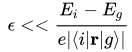
|
(EQ_ beyondone)
|
when  is the nearest state of opposite parity to .
If is the ground state, we can expect 
 Hartree and
  (virial theorem). Hence the Stark shift should be quadratic if the field is well below the critical value

|
(EQ_ beyondtwo)
|
[ is atomic unit of field]
  —a field three orders of magnitude in excess of what can be produced in a laboratory except in a vanishingly small volume.
If is an excited state, say  , this situation changes <it>
dramatically
</it>. In general, the matrix element
, this situation changes <it>
dramatically
</it>. In general, the matrix element  and
and  to the next level of opposite parity depends on the quantum defect:

|
(EQ_ beyondthree)
|
Thus the critical field is lowered to


|
(EQ_ beyondfour)
|
Considering that quantum defects are typically  when
when  is the largest
  of an electron in the core), it is clear that even 1 V/cm fields will exceed
  for higher levels if
  . Large laboratory fields (
 V/cm) can exceed even for
  states if
  .
.
When the electric field exceeds states with different but the same  are degenerate to the extent that their quantum defects are small. Once exceeds the number of core electrons, these states will easily become completely mixed by the field and they must be diagonalized exactly. The result is eigenstates possessing apparently permanent electric dipoles with a resulting linear Stark shift (see following figure). As the field increases, these states spread out in energy. First they run into states with the same but different quantum defects; then the groups of states with different begin to overlap. At this point a matrix containing all
  states with greater or equal to
  must be diagonalized. The only saving grace is that the lowest states do not partake in this strong mixing; however, the states near the continuum always do if there is an
  -field present.\
The situation described above differs qualitatively for hydrogen since it has no quantum defects and the energies are degenerate. In this case the zero-field problem may be solved using a basis which diagonalizes the Hamiltonian both for the atom above and also in the presence of an electric field. This approach corresponds to solving the H atom in parabolic–ellipsoidal coordinates and results in the presence of an integral quantum number which replaces . The resulting states possess permanent dipole moments which vary with this quantum number and therefore have linear Stark effects even in infinitesimal fields. Moreover the matrix elements which mix states from different manifolds vanish at all fields, so the upper energy levels from one manifold cross the lower energy levels from the manifold above without interacting with them.\
The following example shows the high field stark effect for Li. Only the term in Li has an appreciable quantum defect, and it has been suppressed by selecting final states with  .
.
The dramatic difference between the physical properties of atoms with  and the properties of the same atoms in their ground state, coupled with the fact that these properties are largely independent of the type of atom which is excited, justifies the application of the name Rydberg atoms to highly excited atoms in general.\
File:06-E-FIELD/Stark pattern.eps Stark effect and field ionization in Li for levels with

. Each vertical line represents a measurement at that field of the number of atoms excited (from the

state) by radiation whose energy falls the indicated amount below the ionization limit. Thus the patterns made by absorption peaks at successive field strengths represent the behavior of the energy levels with increasing field. At zero field the levels group according to the principal quantum number
; at intermediate field the levels display a roughly linear Stark effect, and at high fields they disappear owing to field ionization. The solid line is the classically predicted ionization field (see next section). Figure taken from Littman, Kash and Kleppner.
