Equation of Motion for the Expectation Value
For the system we have been considering, the Hamiltonian is

Recalling the Heisenberg equation of motion for any operator
 is
is
![{\displaystyle {\frac {d}{dt}}{\hat {O}}={\frac {i}{\hbar }}\left[{\hat {H}},{\hat {O}}\right]+{\frac {\partial {\hat {O}}}{\partial t}}}](https://wikimedia.org/api/rest_v1/media/math/render/svg/ae5069cad777556e25ef2674f2ed7f1fbdc641a0)
where the last term refers to operators with an explicit time dependence, we
have in this instance
![{\displaystyle {\frac {d}{dt}}{\hat {\mu }}_{k}=\gamma {\frac {d}{dt}}{\hat {L}}_{k}={\frac {i\gamma }{\hbar }}\left[{\hat {H}},{\hat {L}}_{k}\right]=-{\frac {i\gamma ^{2}}{\hbar }}B_{0}\left[{\hat {L}}_{z},{\hat {L}}_{k}\right]}](https://wikimedia.org/api/rest_v1/media/math/render/svg/31c5220d2321caf92920986550a99c6ba69fb523)
Using ![{\displaystyle \left[{\hat {L}}_{k},{\hat {L}}_{l}\right]=i\hbar \epsilon _{klm}{\hat {L}}_{m}}](https://wikimedia.org/api/rest_v1/media/math/render/svg/5b0dce00bc29fe901e80ab62151d3d46ed0adb58) with the
Levi-Civita symbol
with the
Levi-Civita symbol  , we have

or in short

These are just like the classical equations of motion
\ref{eq:classical_precession_in_static_field}, but here they describe the
precession of the operator for the magnetic moment  or for the
angular momentum
or for the
angular momentum  about the magnetic field at the (Larmor)
angular frequency
about the magnetic field at the (Larmor)
angular frequency  .
Note that
\begin{itemize}
\item
Just as in the classical model, these operator equations are
exact; we have not neglected any higher order terms.
\item
Since the equations of motion hold for the operator, they must hold for
the expectation value
.
Note that
\begin{itemize}
\item
Just as in the classical model, these operator equations are
exact; we have not neglected any higher order terms.
\item
Since the equations of motion hold for the operator, they must hold for
the expectation value

\item
We have not made use of any special relations for a spin- system, but
just the general commutation relation for angular momentum. Therefore the
result, precession about the magnetic field at the Larmor frequency, remains
true for any value of angular momentum
system, but
just the general commutation relation for angular momentum. Therefore the
result, precession about the magnetic field at the Larmor frequency, remains
true for any value of angular momentum  .
\item
A spin- system has two energy levels, and the two-level problem with
coupling between two levels can be mapped onto the problem for a spin in a
magnetic field, for which we have developed a good classical intuition.
\item
If coupling between two or more angular momenta or spins within an atom
results in an angular momentum
.
\item
A spin- system has two energy levels, and the two-level problem with
coupling between two levels can be mapped onto the problem for a spin in a
magnetic field, for which we have developed a good classical intuition.
\item
If coupling between two or more angular momenta or spins within an atom
results in an angular momentum  , the time evolution of this angular
momentum in an external field is governed by the same physics as for the
two-level system. This is true as long as the applied magnetic field is not
large enough to break the coupling between the angular momenta; a situation
known as the Zeeman regime. Note that if the coupled angular momenta have
different gyromagnetic ratios, the gyromagnetic ratio for the composite angular
momentum is different from those of the constituents.
\item
For large magnetic field the interaction of the individual constituents
with the magnetic field dominates, and they precess separately
about the magnetic field. This is the Paschen-Back regime.
\item
An even more interesting composite angular momentum arises when
, the time evolution of this angular
momentum in an external field is governed by the same physics as for the
two-level system. This is true as long as the applied magnetic field is not
large enough to break the coupling between the angular momenta; a situation
known as the Zeeman regime. Note that if the coupled angular momenta have
different gyromagnetic ratios, the gyromagnetic ratio for the composite angular
momentum is different from those of the constituents.
\item
For large magnetic field the interaction of the individual constituents
with the magnetic field dominates, and they precess separately
about the magnetic field. This is the Paschen-Back regime.
\item
An even more interesting composite angular momentum arises when
 two-level atoms are coupled symmetrically to an external
field. In this case we have an effective angular momentum
two-level atoms are coupled symmetrically to an external
field. In this case we have an effective angular momentum
 for the symmetric coupling (see Figure \ref{fig:dicke_states}).
\begin{figure}
for the symmetric coupling (see Figure \ref{fig:dicke_states}).
\begin{figure}
\caption{Level structure diagram for  two-level atoms in a basis of symmetric
states \cite{Dicke1954}. The leftmost column corresponds to an effective
spin-
two-level atoms in a basis of symmetric
states \cite{Dicke1954}. The leftmost column corresponds to an effective
spin- object. Other columns correspond to manifolds of symmetric states of
the atoms with lower total effective angular momentum.}
object. Other columns correspond to manifolds of symmetric states of
the atoms with lower total effective angular momentum.}
\end{figure}
Again the equation of motion for the composite angular momentum
is a precession. This is the problem considered in Dicke's famous paper
\cite{Dicke1954}, in which he shows that this collective precession can give
rise to massively enhanced couplings to external fields ("superradiance") due
to constructive interference between the individual atoms.
\end{itemize}
The Two-Level System: Spin-1/2
Let us now specialize to the two-level system and calculate the time evolution
of the occupation probabilities for the two levels.
Equivalence of two-level system with spin-. Note that for
 the spin-up state (spin aligned with field) is the ground state. For an electron, with
  , spin-up is the excited state. Be careful, as both conventions are used in the literature.
We have that

where in the last equation we have used the fact that  . The signs
are chosen for a spin with , such as a proton (Figure
\ref{fig:two_level_spin_half}). For an electron, or any other spin with
, the analysis would be the same but for the opposite sign of
. The signs
are chosen for a spin with , such as a proton (Figure
\ref{fig:two_level_spin_half}). For an electron, or any other spin with
, the analysis would be the same but for the opposite sign of  and the corresponding exchange of
  and
and  . If the system is
initially in the ground state,
. If the system is
initially in the ground state,  (or the spin along
 ,
, 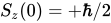 ), the expectation value obeys the classical
equation of motion \ref{eq:classical_rabi_flopping}:
), the expectation value obeys the classical
equation of motion \ref{eq:classical_rabi_flopping}:

Equation \ref{eqn:rabi_transition_probability} is the probability to find system
in the excited state at time  if it was in ground state at time
  .
Figure \ref{fig:rabi_signal} shows a real-world example of such an oscillation.
.
Figure \ref{fig:rabi_signal} shows a real-world example of such an oscillation.
Rabi oscillation signal taken in the Vuleti\'{c} lab shortly after this
topic was covered in lecture in 2008. The amplitude of the oscillations decays
with time due to spatial variations in the strength of the drive field (and
hence of the Rabi frequency), so that the different atoms drift out of phase
with each other.
Matrix form of Hamiltonian
With the matrix representation

we can write the Hamiltonian  associated with the static
field
associated with the static
field  as
as

where  is the Larmor frequency, and
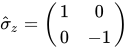
is a Pauli spin matrix. The eigenstates are  ,
,  with
eigenenergies
with
eigenenergies  . A spin initially
along
. A spin initially
along  , corresponding to

evolves in time as

which describes a precession with angluar frequency  .
The field
.
The field  , rotating at
  in the
  plane corresponds to

where have used the Pauli spin matrices  ,
,  . The full
Hamiltonian is thus given by
. The full
Hamiltonian is thus given by

This is the famous "dressed atom" Hamiltonian in the so-called "rotating wave
approximation". Its eigenstates and eigenvalues provide a very elegant, very
intuitive solution to the two-state problem.
Solution of the Schrodinger Equation for Spin-1/2 in the Interaction Representation
The interaction representation consists of expanding the state  in terms of the eigenstates , of the Hamiltonian ,
including their known time dependence
in terms of the eigenstates , of the Hamiltonian ,
including their known time dependence  due to .
That means we write here
due to .
That means we write here

Substituting this into the Schrodinger equation

then results in the equations of motion for the coefficients

Where we have used the matrix form of the Hamiltonian,
\ref{eq:dressed_atom_hamiltonian}. Introducing the detuning
 , we have

The explicit time dependence can be eliminated by the sustitution

As you will show (or have shown) in the problem set, this leads to solutions for
 given by

with two constants that are determined by the initial conditions.
For  we find

as already derived from the fact that the expectation value for
the magnetic moment obeys the classical equation.
Atomic Clocks and the Ramsey Method
When comparing the Hamiltonian for a spin- in a magnetic field to that of a
two-level system with a coupling between the two levels characterized by the
strength  and frequency , we see that the energy spacing
between and corresponds to the Larmor frequency
in the static field. This spacing can provide a frequency or time reference if
perturbations affecting are sufficiently well controlled. For
instance, the time unit "second" is defined via the transition frequency
between two hyperfine states in the electronic ground state of the caesium atom,
which is near \unit{9.2}{\giga\hertz} in the microwave domain. The task of an
atomic clock is then to measure this frequency accurately by trying to tune a
frequency source (the frequency of the rotating field
and frequency , we see that the energy spacing
between and corresponds to the Larmor frequency
in the static field. This spacing can provide a frequency or time reference if
perturbations affecting are sufficiently well controlled. For
instance, the time unit "second" is defined via the transition frequency
between two hyperfine states in the electronic ground state of the caesium atom,
which is near \unit{9.2}{\giga\hertz} in the microwave domain. The task of an
atomic clock is then to measure this frequency accurately by trying to tune a
frequency source (the frequency of the rotating field  in the spin
picture) to the atomic frequency . Equivalently, we want to find the
frequency such that the detuning is equal to
zero.
Starting with an atom in (spin along for
), we could try to find the resonance frequency by noting that
according to
in the spin
picture) to the atomic frequency . Equivalently, we want to find the
frequency such that the detuning is equal to
zero.
Starting with an atom in (spin along for
), we could try to find the resonance frequency by noting that
according to

the population of the upper state is maximized for  (i.e. the
precession of the spin to the
(i.e. the
precession of the spin to the  direction is only complete on
resonance). This is the so-called Rabi method. It suffers from a number of
drawbacks. For one, the signal is only quadratic in the detuning
direction is only complete on
resonance). This is the so-called Rabi method. It suffers from a number of
drawbacks. For one, the signal is only quadratic in the detuning  , i.e.
the method is relatively insensitive near . Furthermore, the optimum
time depends on the strength of the coupling (i.e. the strength
of the rotating field), so fluctuations in can be mistaken for
changes in . Finally the coupling by to other levels can
lead to level shifts that are not intrinsic to the atom, but depend on the
applied drive (Figure \ref{fig:rabi_third_level}).
\begin{figure}
, i.e.
the method is relatively insensitive near . Furthermore, the optimum
time depends on the strength of the coupling (i.e. the strength
of the rotating field), so fluctuations in can be mistaken for
changes in . Finally the coupling by to other levels can
lead to level shifts that are not intrinsic to the atom, but depend on the
applied drive (Figure \ref{fig:rabi_third_level}).
\begin{figure}
\caption{The drive used for Rabi flopping within the , system can
also off-resonantly couple one or both levels to other states, perturbing the
transition frequency .}
\end{figure}
Norman Ramsey invented an alternative method (the so-called "separated
oscillatory fields method", known for short as the "Ramsey method"
\cite{Ramsey1949,Ramsey1950}, for which he received the Nobel prize), that fixes
all of these problems. It leads to a signal that is linear rather than quadratic
in the detuning , does not require tuning the measurement time to match
the applied field strength  , and, most importantly,
eliminates level shifts due to altogether.
The method is as follows. Instead of applying a pulse for a time t that
corresponds to Rabi rotation of the spin by
, and, most importantly,
eliminates level shifts due to altogether.
The method is as follows. Instead of applying a pulse for a time t that
corresponds to Rabi rotation of the spin by  (called a pulse), the
pulse is applied for half that time, corresponding to the Rabi rotation of the
spin by
(called a pulse), the
pulse is applied for half that time, corresponding to the Rabi rotation of the
spin by  into the plane ( pulse). Then the applied field
is turned off and the system is left to precess in the static field
into the plane ( pulse). Then the applied field
is turned off and the system is left to precess in the static field  (or at its natural frequency ) for a measurement time
  . Finally, a
second pulse, identical to the original one, is applied (see Figure
\ref{fig:ramsey_sequence}).
\begin{figure}
. Finally, a
second pulse, identical to the original one, is applied (see Figure
\ref{fig:ramsey_sequence}).
\begin{figure}
\caption{Ramsey sequence}
\end{figure}
The signal is the  component of the spin after the second
interaction. The signal after the second pulse is an oscillating signal
in
component of the spin after the second
interaction. The signal after the second pulse is an oscillating signal
in  , depending on how much phase the spin has acquired relative to the
local oscillator (the microwave signal generator at frequency ).
Examples of such curves are shown in Figures \ref{fig:ramsey_signal} and
\ref{fig:ramsey_vs_freq}.
\begin{figure}
, depending on how much phase the spin has acquired relative to the
local oscillator (the microwave signal generator at frequency ).
Examples of such curves are shown in Figures \ref{fig:ramsey_signal} and
\ref{fig:ramsey_vs_freq}.
\begin{figure}
\caption{Ramsey oscillation signal as a function of time taken in the
Vuleti\'{c} lab in 2007. The drive field was deliberately detuned from
resonance so that the oscillation at the detuning frequency would be visible.}
\end{figure}
\begin{figure}
\caption{Experimental data from Ramsey's original paper \cite{Ramsey1950},
showing the signal as a function of frequency. Note the narrow oscillation,
whose width is set by the measurement time , superimposed on the much broader
background set up by the inhomogeneously broadened pulses.}
\end{figure}
At the zero crossings we have maximum sensitivity of the signal with respect to
frequency changes. Note that the signal as a function of looks similar to
Rabi flopping. However, there the zero crossing measure the Rabi frequency, not
.


