This section introduces the interaction of atoms with radiative modes of the electromagnetic field.
Introduction: Spontaneous and Stimulated Emission
Einstein's 1917 paper on the theory of radiation
\footnote{A. Einstein, Z. Phys. 18, 121 (1917), translated in
Sources of Quantum Mechanics, B. L. Van der Waerden, Cover
Publication, Inc., New York, 1967. This book is a gold mine for anyone
interested in the development of quantum mechanics.} provided seminal
concepts for the quantum theory of radiation. It also anticipated
devices such as the laser, and pointed the way to the field of
laser-cooling of atoms. In it, he set out to answer two questions:
1) How do the internal states of an atom that radiates and absorbs
energy come into equilibrium with a thermal radiation field? (In answering this
question Einstein invented the concept of spontaneous emission)
2) How do the translational states of an atom in thermal
equilibrium (i.e. states obeying the Maxwell-Boltzmann Law for the
distribution of velocities) come into thermal equilibrium with a
radiation field? (In answering this question, Einstein introduced the concept
of photon recoil. He also demonstrated that the field itself must
obey the Planck radiation law.)
The first part of Einstein's paper, which addresses question 1), is
well known, but the second part, which addresses question 2), is every
bit as germane for contemporary atom/optical physics. Because the
paper preceded the creation of quantum mechanics there was no way for
him to calculate transition rates. However, his arguments are based
on general statistical principles and provide the foundation for
interpreting the quantum mechanical results.
Einstein considered a system of  atoms in thermal equilibrium
with a radiation field. The system has two levels\footnote{An
energy level consists of all of the states that have a given
energy. The number of quantum states in a given level is its
multiplicity.} with energies
atoms in thermal equilibrium
with a radiation field. The system has two levels\footnote{An
energy level consists of all of the states that have a given
energy. The number of quantum states in a given level is its
multiplicity.} with energies  and
and  , with
  ,
and
,
and  . The numbers of atoms in the two
levels are related by
. The numbers of atoms in the two
levels are related by  . Einstein assumed the Planck
radiation law for the spectral energy density
temperature. For radiation in thermal equilibrium
at temperature
. Einstein assumed the Planck
radiation law for the spectral energy density
temperature. For radiation in thermal equilibrium
at temperature  , the energy per unit volume in wavelength range
  is:
is:

The mean occupation number of a harmonic oscillator at
temperature , which can be interpreted as
the mean number of photons in one mode of the radiation field, is

According to the Boltzmann Law of statistical mechanics, in thermal equilibrium
the populations of the
two levels are related by

The last step assumes the Bohr frequency condition,
 . However, Einstein's paper actually
derives this relation independently.
. However, Einstein's paper actually
derives this relation independently.
According to classical theory, an
oscillator can exchange energy with the radiation field at a rate
that is proportional to the spectral density of radiation. The
rates for absorption and emission are equal. The
population transfer rate equation is thus predicted to be

This equation is incompatible with Eq.~\ref{erad3}. To overcome
this problem, Einstein postulated that atoms in state b must
spontaneously radiate to state a, with a constant radiation rate
 . Today such a process seems quite natural: the language
of quantum mechanics is the language of probabilities and there
is nothing jarring about asserting that the probability of
radiating in a short time interval is proportional to the length
of the interval. At that time such a random fundamental process could not be
justified on physical principles. Einstein, in his characteristic Olympian style, brushed
aside such concerns and merely asserted that the process is
analagous to radioactive decay. With this addition,
Eq.~\ref{erad4} becomes
. Today such a process seems quite natural: the language
of quantum mechanics is the language of probabilities and there
is nothing jarring about asserting that the probability of
radiating in a short time interval is proportional to the length
of the interval. At that time such a random fundamental process could not be
justified on physical principles. Einstein, in his characteristic Olympian style, brushed
aside such concerns and merely asserted that the process is
analagous to radioactive decay. With this addition,
Eq.~\ref{erad4} becomes
![{\displaystyle {\dot {N}}_{b}=-{\left[\rho _{E}(\omega )B_{ba}+A_{ba}\right]}N_{b}+\rho _{E}(\omega )B_{ab}N_{a}=-{\dot {N}}_{a}.}](https://wikimedia.org/api/rest_v1/media/math/render/svg/c9f543f1393f48395215bb5fe7fa7a0074d1d0de)
it follows that


while the rate of absorption is

If we consider emission and absorption between single states by
taking  , then the
ratio of rate of emission to rate of absorption is
, then the
ratio of rate of emission to rate of absorption is  .
.
This argument reveals the fundamental role of spontaneous
emission. Without it, atomic systems could not achieve thermal
equilibrium with a radiation field. Thermal equilibrium requires
some form of dissipation, and dissipation is equivalent to having
an irreversible process. Spontaneous emission is the fundamental
irreversible process in nature. The reason that it is
irreversible is that once a photon is radiated into the vacuum,
the probability that it will ever be reabsorbed is zero: there
are an infinity of vacuum modes available for emission but only
one mode for absorption. If the vacuum modes are limited, for
instance by cavity effects, the number of modes becomes finite and
equilibrium is never truly achieved. In the limit of only a
single mode, the motion becomes reversible.
The identification of the Einstein  coefficient with the rate
of spontaneous emission is so well established that we shall
henceforth use the symbol to denote the spontaneous
decay rate from state
coefficient with the rate
of spontaneous emission is so well established that we shall
henceforth use the symbol to denote the spontaneous
decay rate from state  to
to  . The radiative lifetime for
such a transition is
. The radiative lifetime for
such a transition is  .
.
Here, Einstein came to a halt. Lacking quantum theory, there was
no way to calculate .
Quantum Theory of Absorption and Emission
We shall start by describing the behavior of an atom in a
classical electromagnetic field. Although treating the field
classically while treating the atom quantum mechanically is
fundamentally inconsistent, it provides a natural and intuitive
approach to the problem. Furthermore, it is completely justified
in cases where the radiation fields are large, in the sense that
there are many photons in each mode, as for instance, in the
case of microwave or laser spectroscopy. There is, however, one
important process that this approach cannot deal with
satisfactorily. This is spontaneous emission, which we shall treat
later using a quantized field. Nevertheless, phenomenological
properties such as selection rules, radiation rates and cross
sections, can be developed naturally with this approach.
The classical E-M field
Our starting point is Maxwell's equations (S.I. units):

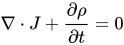
The charge density  and current density J obey the
continuity equation
and current density J obey the
continuity equation
Introducing the vector potential A and the scalar potential
 , we have

We are free to change the potentials by a gauge transformation:

where  is a scalar function. This transformation leaves
the fields invariant, but changes
the form of the dynamical equation. We shall work in the {\it
Coulomb gauge} (often called the
radiation gauge), defined by
is a scalar function. This transformation leaves
the fields invariant, but changes
the form of the dynamical equation. We shall work in the {\it
Coulomb gauge} (often called the
radiation gauge), defined by

In free space, A obeys the wave equation

Because , A is transverse. We
take a propagating plane wave
solution of the form
![{\displaystyle A(r,t)=A{\hat {e}}\cos(k\cdot r-\omega t)=A{\hat {e}}{\frac {1}{2}}\left[e^{i(k\cdot r-\omega t)}+e^{-i(k\cdot r-\omega t)}\right],}](https://wikimedia.org/api/rest_v1/media/math/render/svg/dbcb2407ab0a6a6c493ecb90780986d8a5859ab1)
For a linearly polarized field, the polarization vector  is real. For an elliptically polarized field it is
complex, and for a circularly polarized field it is given by
is real. For an elliptically polarized field it is
complex, and for a circularly polarized field it is given by
 , where the + and
  signs correspond to positive and negative
helicity, respectively. (Alternatively, they correspond to left
and right hand circular polarization, respectively, the sign
convention being a tradition from optics.) The
electric and magnetic fields are then given by
signs correspond to positive and negative
helicity, respectively. (Alternatively, they correspond to left
and right hand circular polarization, respectively, the sign
convention being a tradition from optics.) The
electric and magnetic fields are then given by
![{\displaystyle E(r,t)=\omega A{\hat {e}}\sin(k\cdot r-\omega t)=-i\omega A{\hat {e}}{\frac {1}{2}}\left[e^{i(k\cdot r-\omega t)}-e^{-i(k\cdot r-\omega t)}\right].}](https://wikimedia.org/api/rest_v1/media/math/render/svg/a8a4afb62aa1f52dccd2078b06c5716f3e510810)
![{\displaystyle B(r,t)=k({\hat {k}}\times {\hat {e}})\sin(k\cdot r-\omega t)=-ikA({\hat {k}}\times {\hat {e}}){\frac {1}{2}}\left[e^{i(k\cdot r-\omega t)}-e^{-i(k\cdot r-\omega t)}\right].}](https://wikimedia.org/api/rest_v1/media/math/render/svg/bdc699e81062eb5aeaf8a066b5ed869c133d69a5)
The time average Poynting vector is

The average energy density in the wave is given by

Interaction of an electromagnetic wave and an atom
The behavior of charged particles in an electromagnetic field is
correctly described by Hamilton's
equations provided that the canonical momentum is redefined:

The kinetic energy is  . Taking
  , the Hamiltonian for an atom in an
electromagnetic field in free space is
, the Hamiltonian for an atom in an
electromagnetic field in free space is

internal interactions. We are
neglecting spin interactions.
Expanding and rearranging, we have

Here,  . Consequently,
  describes the unperturbed atom.
 describes the atom's interaction with the field.
 , which is second order in
A, plays a role only at very high intensities. (In a static
magnetic field, however,
gives rise to diamagnetism.)
, which is second order in
A, plays a role only at very high intensities. (In a static
magnetic field, however,
gives rise to diamagnetism.)
Because we are working in the Coulomb gauge, so that A and p
commute. We have

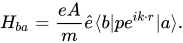
It is convenient to write the matrix element between states  and
and  in the form

where
Atomic dimensions are small compared to the wavelength of
radiation involved in optical transitions. The scale of the
ratio is set by  . Consequently, when the
matrix element in Eq. \ref{EQ_int6} is evaluated, the wave
function vanishes except in the region where
. Consequently, when the
matrix element in Eq. \ref{EQ_int6} is evaluated, the wave
function vanishes except in the region where  . It is therefore appropriate to
expand the exponential:
. It is therefore appropriate to
expand the exponential:

Unless  vanishes, for instance
due to parity considerations, the
leading term dominates and we can neglect the others. For reasons
that will become clear, this is
called the dipole approximation. This is by far the most important
situation, and we shall defer
consideration of the higher order terms. In the dipole
approximation we have
vanishes, for instance
due to parity considerations, the
leading term dominates and we can neglect the others. For reasons
that will become clear, this is
called the dipole approximation. This is by far the most important
situation, and we shall defer
consideration of the higher order terms. In the dipole
approximation we have

where we have used, from Eq. \ref {eq:E-field},  .
It can be shown (i.e. left as exercise) that the matrix element of p
can be transfomred into a matrix element for
.
It can be shown (i.e. left as exercise) that the matrix element of p
can be transfomred into a matrix element for  :
:

This results in

We will be interested in resonance phenomena in which  . Consequently,

where d is the dipole operator,  .
Displaying the time dependence explictlty, we have
.
Displaying the time dependence explictlty, we have

However, it is important to bear in mind that this is only the first
term in a series, and that if it vanishes the higher order terms
will contribute a perturbation at the driving frequency.
 appears as a matrix element of the momentum operator {\bf
p} in Eq.\ \ref{EQ_int8}, and of the dipole operator r in
Eq.\ \ref{EQ_int11}. These matrix elements look different and
depend on different parts of the wave function. The momentum
operator emphasizes the curvature of the wave function, which is
largest at small distances, whereas the dipole operator evaluates
the moment of the charge distribution, i.e. the long range
behavior. In practice, the accuracy of a calculation can depend
significantly on which operator is used.
appears as a matrix element of the momentum operator {\bf
p} in Eq.\ \ref{EQ_int8}, and of the dipole operator r in
Eq.\ \ref{EQ_int11}. These matrix elements look different and
depend on different parts of the wave function. The momentum
operator emphasizes the curvature of the wave function, which is
largest at small distances, whereas the dipole operator evaluates
the moment of the charge distribution, i.e. the long range
behavior. In practice, the accuracy of a calculation can depend
significantly on which operator is used.
Quantization of the radiation field
We shall consider a single mode of the radiation field. This means
a single value of the wave
vector k, and one of the two orthogonal transverse
polarization vectors  .
The radiation field is described by a plane wave vector potential
of the form Eq.~\ref{eq:A-field}.
We assume that k obeys a periodic boundary or condition,
.
The radiation field is described by a plane wave vector potential
of the form Eq.~\ref{eq:A-field}.
We assume that k obeys a periodic boundary or condition,  , etc. (For any
k, we can choose boundaries
, etc. (For any
k, we can choose boundaries  to satisfy
this.) The time averaged energy density is given by Eq.~\ref{eq:energy-density}, and
the total energy in the volume V defined by these boundaries is
to satisfy
this.) The time averaged energy density is given by Eq.~\ref{eq:energy-density}, and
the total energy in the volume V defined by these boundaries is

where  is the mean squared value of averaged over the spatial mode.
We now make a formal connection between the radiation field and a
harmonic oscillator. We define variables Q and P by
is the mean squared value of averaged over the spatial mode.
We now make a formal connection between the radiation field and a
harmonic oscillator. We define variables Q and P by


This describes the energy of a harmonic oscillator having unit
mass. We quantize the oscillator in
the usual fashion by treating Q and P as operators, with
![{\displaystyle P=-i\hbar {\frac {\partial }{\partial Q}},~~~[Q,P]=i\hbar .}](https://wikimedia.org/api/rest_v1/media/math/render/svg/c0f4a86de223c4041b50e415b676d158839a50ff)
We introduce the operators and  defined by


The fundamental commutation rule is
![{\displaystyle [a,a^{\dagger }]=1}](https://wikimedia.org/api/rest_v1/media/math/render/svg/671da8b1eb59fe1c04e601cc7963a6511d88c74e)
from which the following can be deduced:
![{\displaystyle H={\frac {1}{2}}\hbar \omega [a^{\dagger }a+aa^{\dagger }]=\hbar \omega \left[a^{\dagger }a+{\frac {1}{2}}\right]=\hbar \omega \left[N+{\frac {1}{2}}\right]}](https://wikimedia.org/api/rest_v1/media/math/render/svg/78f6c3412c62211a735b39336a8d49f148a2c57a)
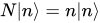
where the number operator  obeys
obeys
We also have

The operators and are called the
annihilation and creation operators, respectively.
We can express the vector potential and electric field in terms of
and as follows


![{\displaystyle E=-i{\sqrt {\frac {\hbar \omega }{2\epsilon _{o}V}}}{\left[a{\hat {e}}e^{i(k\cdot r-\omega t)}-a^{\dagger }{\hat {e}}^{*}e^{-i(k\cdot r-\omega t)}\right]}}](https://wikimedia.org/api/rest_v1/media/math/render/svg/ede885f802d6551b812449c6af6e765bd848befb)
In the dipole limit we can take  .
Then
.
Then
![{\displaystyle E=-i{\sqrt {\frac {\hbar \omega }{2\epsilon _{o}V}}}\left[a{\hat {e}}-a^{\dagger }{\bf {\hat {e}}}^{*}\right]}](https://wikimedia.org/api/rest_v1/media/math/render/svg/665371dd3e47030dbc1c952ddd7823507fda64ec)
The interaction Hamiltonian is,
![{\displaystyle H_{\rm {int}}=-ie{\sqrt {\frac {\hbar \omega }{2\epsilon _{o}V}}}r\cdot {\left[a{\hat {e}}e^{-i\omega t}-a^{\dagger }{\hat {e}}^{*}e^{+i\omega t}\right]},}](https://wikimedia.org/api/rest_v1/media/math/render/svg/97906c3507e98f418be52d5b6c341ecbefca5a71)
\section{Interaction of a two-level system and a single mode of the
radiation field}
We consider a two-state atomic system ,\ and a radiation field described by  The states of the total system can be taken to be

We shall take  . Then

The first term in the bracket obeys the selection rule  . This corresponds to loss of one photon from the field and
absorption of one photon by the atom. The second term obeys
. This corresponds to loss of one photon from the field and
absorption of one photon by the atom. The second term obeys  . This corresponds to emission of a photon by the atom.
Using Eq.\ \ref{EQ_qrd13}, we have
. This corresponds to emission of a photon by the atom.
Using Eq.\ \ref{EQ_qrd13}, we have

Transitions occur when the total time dependence is zero, or near
zero. Thus absorption occurs
when  , or
, or  . As
we expect, energy is conserved.
Similarly, emission occurs when
. As
we expect, energy is conserved.
Similarly, emission occurs when  , or
, or  .
.
A particularly interesting case occurs when  , i.e.\ the
field is initially in the vacuum
state, and
, i.e.\ the
field is initially in the vacuum
state, and  . Then

The situation describes a constant perturbation  coupling the two states
  and
and 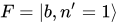 . The states are
degenerate because
. The states are
degenerate because  . Consequently, is the upper of the two atomic
energy levels.
. Consequently, is the upper of the two atomic
energy levels.
The system is composed of two degenerate eigenstates, but due to
the coupling of the field, the
degeneracy is split. The eigenstates are symmetric and
antisymmetric combinations of the initial
states, and we can label them as

The energies of these states are

If at  , the atom is in state which means
that the radiation field is in state
, the atom is in state which means
that the radiation field is in state
 then the system is in a superposition state:

The time evolution of this superposition is given by

where  . The probability
that the atom is in state at a later time is
. The probability
that the atom is in state at a later time is

The frequency  is called the vacuum Rabi frequency.
The dynamics of a 2-level atom interacting with a single mode of
the vacuum were first analyzed in
Ref.\ \cite{JAC63} and the oscillations are sometimes called {\it
Jaynes-Cummings} oscillations.
The atom-vacuum interaction , Eq.\ \ref{EQ_vac4}, has a
simple physical interpretation.
The electric field amplitude associated with the zero point
energy in the cavity is given by

Consequently,  . The
interaction frequency
. The
interaction frequency  is sometimes referred to as the vacuum Rabi frequency,
although, as we have seen, the
actual oscillation frequency is
is sometimes referred to as the vacuum Rabi frequency,
although, as we have seen, the
actual oscillation frequency is  .
.
Absorption and emission are closely related. Because the rates
are proportional to  , it is evident from Eq.\
\ref{EQ_vac3} that
, it is evident from Eq.\
\ref{EQ_vac3} that

This result, which applies to radiative transitions between any
two states of a system, is general.
In the absence of spontaneous emission, the absorption and
emission rates are identical.
The oscillatory behavior described by Eq.\ \ref{EQ_vac8} is
exactly the opposite of free space behavior in which an excited
atom irreversibly decays to the lowest available state by
spontaneous emission. The distinction is that in free space there
are an infinite number of final states available to the photon,
since it can go off in any direction, but in the cavity there is
only one state. The natural way to regard the atom-cavity system
is not in terms of the atom and cavity separately, as in Eq.\
\ref{EQ_vac1}, but in terms of the coupled states  and
and  (Eq.\ \ref{EQ_vac5}). Such states, called {\it
dressed atom} states, are the true eigenstates of the atom-cavity
system.
(Eq.\ \ref{EQ_vac5}). Such states, called {\it
dressed atom} states, are the true eigenstates of the atom-cavity
system.
Absorption and emission
In Chapter 6, first-order perturbation theory was applied to find
the response of a system initially in state to a
perturbation of the form  . The
result is that the amplitude for state is given by
. The
result is that the amplitude for state is given by
![{\displaystyle a_{b}(t)={\frac {1}{2i\hbar }}\int _{0}^{t}H_{ba}e^{-i(\omega -\omega _{ba})t^{\prime }}dt^{\prime }={\frac {H_{ba}}{2\hbar }}{\left[{\frac {e^{-i(\omega -\omega _{ba})t}-1}{\omega -\omega _{ba}}}\right]}}](https://wikimedia.org/api/rest_v1/media/math/render/svg/83c32557d329603b9fae71a5a92eb5f9f24db3e2)
The  term gives
rise to resonance at
term gives
rise to resonance at  ; the
; the  term gives
rise to resonance at . One term is responsible for absorption, the other is responsible
for emission.
term gives
rise to resonance at . One term is responsible for absorption, the other is responsible
for emission.
The probability that the
system has made a transition to
state at time  is
is
![{\displaystyle W_{a\rightarrow b}=|a_{b}(t)|^{2}={\frac {|H_{ba}|^{2}}{\hbar ^{2}}}{\frac {\sin ^{2}[(\omega -\omega _{ba})t/2]}{((\omega -\omega _{ba})/2)^{2}}}}](https://wikimedia.org/api/rest_v1/media/math/render/svg/b144a33a9f9c2c8ee86aef960b2b78281485bb65)
In the limit  , we have

So, for short time,  increases quadratically.
This is reminiscent of a Rabi resonance in a 2-level system in the
limit of short time.
increases quadratically.
This is reminiscent of a Rabi resonance in a 2-level system in the
limit of short time.
However, Eq.\ \ref{EQ_abem2} is only valid provided
 , or for time
  . For such a short time, the incident radiation
will have a spectral width
. For such a short time, the incident radiation
will have a spectral width
 . In this case, we must integrate Eq.\
\ref{EQ_abem2} over the spectrum.
In doing this, we shall make use of the relation
. In this case, we must integrate Eq.\
\ref{EQ_abem2} over the spectrum.
In doing this, we shall make use of the relation
![{\displaystyle \int _{-\infty }^{+\infty }{\frac {\sin ^{2}(\omega -\omega _{ba})t/2}{[(\omega -\omega _{ba})/2]^{2}}}d\omega =2t\int _{-\infty }^{+\infty }{\frac {\sin ^{2}(u-u_{o})}{(u-u_{o})^{2}}}du\rightarrow 2\pi t\int _{-\infty }^{+\infty }\delta (\omega -\omega _{ba})d\omega .}](https://wikimedia.org/api/rest_v1/media/math/render/svg/9c8af10224293850d71d382751db57dd09a5dc08)
Eq.\ \ref{EQ_abem2} becomes

The  -function requires that eventually be integrated over a spectral
distribution function. can also be written
-function requires that eventually be integrated over a spectral
distribution function. can also be written

Because the transition probability is proportional to the time, we
can define the transition rate


The -function arises because of the assumption in first
order perturbation theory that the
amplitude of the initial state is not affected significantly.
This will not be the case, for
instance, if a monochromatic radiation field couples the two
states, in which case the amplitudes
oscillate between 0 and 1. However, the assumption of perfectly
monochromatic radiation is in itself unrealistic.
Radiation always has some spectral width.  is
proportional to the intensity of
the radiation field at resonance. The intensity can be written in
terms of a spectral density
function
is
proportional to the intensity of
the radiation field at resonance. The intensity can be written in
terms of a spectral density
function

where
 is the incident Poynting
vector, and f(
is the incident Poynting
vector, and f( ) is a normalized line shape
function centered at the frequency
which obeys
) is a normalized line shape
function centered at the frequency
which obeys  . We can define a
characteristic spectral width of
. We can define a
characteristic spectral width of  by
by

Integrating Eq.\ \ref{EQ_abem7b} over the spectrum of the
radiation gives

If we define the effective Rabi frequency by

then

Another situation that often occurs is when the radiation is
monochromatic, but the final state is
actually composed of many states spaced close to each other in
energy so as to form a continuum.
If such is the case, the density of final states can be described
by

where  is the number of states in range
  . Taking
 in Eq.\
\ref{EQ_abem7b}, and integrating gives
in Eq.\
\ref{EQ_abem7b}, and integrating gives

This result remains valid in the limit  , where
 . In this
static situation, the result is known as {\it Fermi's Golden Rule}.
. In this
static situation, the result is known as {\it Fermi's Golden Rule}.
Note that Eq.\ \ref{EQ_abem9} and Eq.\ \ref{EQ_abem13} both
describe a uniform rate process in
which the population of the initial state decreases exponentially
in time. If the population of
the initial state is  , then

Applying this to the dipole transition described in Eq.\
\ref{EQ_int11}, we have

The arguments here do not distinguish whether  or
or  (though the
sign of
(though the
sign of  obviously does). In the
former case the process is
absorption, in the latter case it is emission.
obviously does). In the
former case the process is
absorption, in the latter case it is emission.
Spontaneous emission rate
The rate of absorption for the transition  ,
where , is, from Eq.\
\ref{EQ_qrd16} and Eq.~\ref{EQ_abem7b},
,
where , is, from Eq.\
\ref{EQ_qrd16} and Eq.~\ref{EQ_abem7b},

where  . To evaluate this we
need to let
. To evaluate this we
need to let  , where
  is the number of photons in the
frequency interval , and
integrate over the spectrum. The result is
is the number of photons in the
frequency interval , and
integrate over the spectrum. The result is

To calculate  , we first calculate the mode density
in space by applying the usual
periodic boundary condition
, we first calculate the mode density
in space by applying the usual
periodic boundary condition

The number of modes in the range  is
is

Letting  be the average number of photons per mode,
then
be the average number of photons per mode,
then

Introducing this into Eq.\ \ref{EQ_sem2} gives

We wish to apply this to the case of isotropic radiation in free
space, as, for instance, in a
thermal radiation field. We can take  to lie along
the
to lie along
the  axis and describe k
in spherical coordinates about this axis. Since the wave is
transverse,
axis and describe k
in spherical coordinates about this axis. Since the wave is
transverse,  . However, there are 2 orthogonal
polarizations. Consequently,
. However, there are 2 orthogonal
polarizations. Consequently,

Introducing this into Eq.\ \ref{EQ_sem6} yields the absorption rates

It follows that the emission rate for the transition
 is
is

If there are no photons present, the emission rate---called the
rate of spontaneous emission---is

In atomic units, in which  , we have

Taking, typically,  , and
, and  , we have
 . The "
 "
of a radiative transition is
"
of a radiative transition is 
 .
The
.
The  dependence of
  indicates that radiation
is fundamentally a weak process:
hence the high and the relatively long radiative lifetime of
a state,
indicates that radiation
is fundamentally a weak process:
hence the high and the relatively long radiative lifetime of
a state,  . For
example, for the
. For
example, for the  transition in hydrogen (the
 transition), we have
 , and taking
  , we find
  atomic units, or 0.8 ns. The actual lifetime is 1.6 ns.
The lifetime for a strong transition in the optical region is
typically 10--100 ns. Because of the
 dependence of
  , the radiative lifetime for
a transition in the microwave
region---for instance an electric dipole rotational transition
in a molecule---is longer by the
factor
, the radiative lifetime for
a transition in the microwave
region---for instance an electric dipole rotational transition
in a molecule---is longer by the
factor  , yielding lifetimes
on the order of months. Furthermore, if the transition moment
is magnetic dipole rather than
electric dipole, the lifetime is further increased by a factor
of
, yielding lifetimes
on the order of months. Furthermore, if the transition moment
is magnetic dipole rather than
electric dipole, the lifetime is further increased by a factor
of  , giving a time of thousands of years.
Line Strength
Because the absorption and stimulated emission rates are
proportional to the spontaneous emission rate, we shall focus our
attention on the Einstein A coefficient:

where

For an isolated atom, the initial and final states will be
eigenstates of total angular momentum. (If there is an accidental
degeneracy, as in hydrogen, it is still possible to select
angular momentum eigenstates.) If the final angular momentum is
 , then the atom can decay into each of the
  final
states, characterized by the azimuthal quantum number
final
states, characterized by the azimuthal quantum number  . Consequently,

The upper level, however, is also degenerate, with a ( )--fold degeneracy. The lifetime cannot depend on which state
the atom happens to be in. This follows from the isotropy of
space:
)--fold degeneracy. The lifetime cannot depend on which state
the atom happens to be in. This follows from the isotropy of
space:  depends on the orientation of
  with
respect to some direction in space, but the decay rate for an
isolated atom can't depend on how the atom happens to be
oriented. Consequently, it is convenient to define the {\it line
strength}
with
respect to some direction in space, but the decay rate for an
isolated atom can't depend on how the atom happens to be
oriented. Consequently, it is convenient to define the {\it line
strength}  , given by

Then,

The line strength is closely related to the average oscillator
strength  . is obtained by averaging
 over the initial state , and summing over the
values of
over the initial state , and summing over the
values of  in the final state, . For absorption,
 , and
, and

It follows that

In terms of the oscillator strength, we have


Excitation by narrow and broad band light sources
We have calculated the rate of absorption and emission of an atom
in a thermal field, but a more common situation involves
interaction with a light beam, either monochromatic or broad
band. Here "broad band" means having a spectral width that is
broad compared to the natural line width of the system---the
spontaneous decay rate.
For an electric dipole transition, the radiation interaction is

where  is the amplitude of the field. The transition rate, from
Eq.\ \ref{EQ_sem7}, is
is the amplitude of the field. The transition rate, from
Eq.\ \ref{EQ_sem7}, is

where and  is the
normalized line shape function, or alternatively, the normalized
density of states, expressed in frequency units. The transition
rate is proportional to the intensity
is the
normalized line shape function, or alternatively, the normalized
density of states, expressed in frequency units. The transition
rate is proportional to the intensity  of a monochromatic
radiation source. is given by the Poynting vector, and can
be expressed by the electric field as
of a monochromatic
radiation source. is given by the Poynting vector, and can
be expressed by the electric field as  .
Consequently,
.
Consequently,

In the case of a Lorentzian line having a FWHM of  centered on frequency
  ,
,

In this case,

Note that  is the rate of transition between two
particular
quantum states, not the total rate between energy levels.
Naturally,
we also have
is the rate of transition between two
particular
quantum states, not the total rate between energy levels.
Naturally,
we also have  .\\
.\\
An alternative way to express Eq.\ \ref{EQ_broad2} is to
introduce the Rabi frequency,

In which case

If the width of the final state is due soley to spontaneous
emission,
 .
Since is proportional to
.
Since is proportional to  ,
it is independent of
,
it is independent of  .
It is left as a problem to find the exact relationship,
but it can readily be seen that it is of the form
.
It is left as a problem to find the exact relationship,
but it can readily be seen that it is of the form

where X is a numerical factor.  is the photon
flux---i.e. the number of photons
per second per unit area in the beam. Since is an
excitation rate, we interpret
is the photon
flux---i.e. the number of photons
per second per unit area in the beam. Since is an
excitation rate, we interpret
 as the resonance absorption cross section for the
atom,
as the resonance absorption cross section for the
atom,  .
.
At first glance it is puzzling that does not depend on
the structure of the atom; one might expect that a transition
with a large oscillator strength---i.e. a large value of  ---should have a large absorption cross section. However, the
absorption rate is inversely proportional to the linewidth, and
since that also increases with , the two factors
cancel out. This behavior is not limited to electric dipole
transitions, but is quite general.
---should have a large absorption cross section. However, the
absorption rate is inversely proportional to the linewidth, and
since that also increases with , the two factors
cancel out. This behavior is not limited to electric dipole
transitions, but is quite general.
There is, however, an important feature of absorption that does
depend on the oscillator strength. is the cross
section assuming that the radiation is monochromatic compared to
the natural line width. As the spontaneous decay rate becomes
smaller and smaller, eventually the natural linewidth becomes
narrower than the spectral width of the laser, or whatever source
is used. In that case, the excitation becomes broad band.
We now discuss broad band excitation. Using the result of the last
section, finding the excitation rate or the absorption cross
section for broad band excitation is trivial. From Eq.\
\ref{EQ_broad2}, the absorption rate is proportional to
 . For monochromatic excitation,
  and
and  .
For a spectral source having linewidth
.
For a spectral source having linewidth  , defined
so that the normalized line shape function is
, defined
so that the normalized line shape function is  , then the broad band excitation
rate is obtained by replacing with in
Eq.\ \ref{EQ_broad8}. Thus
, then the broad band excitation
rate is obtained by replacing with in
Eq.\ \ref{EQ_broad8}. Thus

Similarly, the effective absorption cross section is

This relation is valid provided  .
If the two widths are comparable, the problem needs to be worked
out
in detail, though the general behavior would be for
.
If the two widths are comparable, the problem needs to be worked
out
in detail, though the general behavior would be for
 . Note
that represents the actual resonance width.
Thus,
if Doppler broadening is the major broadening mechanism then
. Note
that represents the actual resonance width.
Thus,
if Doppler broadening is the major broadening mechanism then

Except in the case of high resolution laser spectroscopy, it is
generally true that , so that
 .
.
Higher-order radiation processes
The atom-field interaction is given by Eq.\ \ref{EQ_int6}

For concreteness, we shall take A(r) to be a plane
wave of
the form

Expanding the exponential, we have

If dipole radiation is forbidden, for instance if
and
have the same parity, then the second term in the
parentheses must be considered. We can rewrite it as follows:

The first term is  , and the matrix element becomes

where 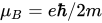 is the Bohr magneton.
The magnetic field, is  .
Consequently, Eq.\ \ref{EQ_hor5} can be written in the more
familiar form
.
Consequently, Eq.\ \ref{EQ_hor5} can be written in the more
familiar form  (The orbital magnetic moment is
  : the minus sign arises from our convention that
  is
positive.)
is
positive.)
We can readily generalize the matrix element to

where  indicates that the matrix element is for a magnetic
dipole
transition.
indicates that the matrix element is for a magnetic
dipole
transition.
The second term in Eq.\ \ref{EQ_hor4} involves  .
Making use of the commutator relation
.
Making use of the commutator relation ![{\displaystyle [r,H_{0}]=i\hbar p/m}](https://wikimedia.org/api/rest_v1/media/math/render/svg/ff1ce0c55d5b95d0e4b94f59cfe038fd2cf74902) , we
have
, we
have
![{\displaystyle {\frac {1}{2}}(p_{z}x+zp_{x})={\frac {m}{2i\hbar }}([z,H_{0}]x+z[x,H_{0}])={\frac {m}{2i\hbar }}(-H_{0}zx+zxH_{0})}](https://wikimedia.org/api/rest_v1/media/math/render/svg/46ef033f054e58995b48686b4a5bc3b45bde0612)
So, the contribution of this term to the matrix element in
Eq.\ \ref{EQ_hor3} is

where we have taken  . This is an electric
quadrupole interaction, and we shall denote the matrix element by
. This is an electric
quadrupole interaction, and we shall denote the matrix element by

The prime indicates that we are considering only one component of
a
more general expression.
The total matrix element from Eq.\ \ref{EQ_hor3} can be written

where the superscript (2) indicates that we are looking at the
second
term in the expansion of Eq.\ \ref{EQ_hor3}. Note that
 is
real, whereas
is
real, whereas  is imaginary. Consequently,

The magnetic dipole and electric quadrupole terms do not
interfere.
The magnetic dipole interaction,

is of order  compared to an electric dipole interaction
because
compared to an electric dipole interaction
because
 atomic units.
The electric quadrupole interaction

is also of order . Because transitions rates depend on , the magnetic dipole and electric quadrupole rates
are both smaller than the dipole rate by  .
For this reason they are generally referred to as {\it forbidden}
processes. However, the term is used somewhat loosely, for there
are
transitions which are much more strongly suppressed due to other
selection rules, as for instance triplet to singlet transitions in
helium.
.
For this reason they are generally referred to as {\it forbidden}
processes. However, the term is used somewhat loosely, for there
are
transitions which are much more strongly suppressed due to other
selection rules, as for instance triplet to singlet transitions in
helium.
Selection rules
The dipole matrix element for a particular polarization of the
field,
, is

It is straightforward to calculate  but a
more general approach is to
write r in terms of a spherical tensor. This yields the
selection rules directly, and allows
the matrix element to be calculated for various geometries using
the Wigner-Eckart theorem, as
discussed in various quantum mechanics text books.
but a
more general approach is to
write r in terms of a spherical tensor. This yields the
selection rules directly, and allows
the matrix element to be calculated for various geometries using
the Wigner-Eckart theorem, as
discussed in various quantum mechanics text books.
The orbital angular momentum operator of a system with total
angular momentum  can be written in
terms of a spherical harmonic
can be written in
terms of a spherical harmonic  . Consequently, the
spherical harmonics constitute spherical
tensor operators. A vector can be written in terms of spherical
harmonics of rank 1. This permits
the vector operator r to be expressed in terms of the
spherical tensor
. Consequently, the
spherical harmonics constitute spherical
tensor operators. A vector can be written in terms of spherical
harmonics of rank 1. This permits
the vector operator r to be expressed in terms of the
spherical tensor 
The spherical harmonics of rank 1 are

These are normalized so that

We can write the vector r in terms of
components  ,
,

or, more generally

Consequently,


The first factor is independent of . It is

where  contains the radial part of the matrix element.
It vanishes unless and have opposite
parity. The second factor in Eq.\ \ref{EQ_select7} yields the
selection rule
contains the radial part of the matrix element.
It vanishes unless and have opposite
parity. The second factor in Eq.\ \ref{EQ_select7} yields the
selection rule

Similarly, for magnetic dipole transition, Eq.\ \ref{EQ_hor6}, we
have

It immediately follows that parity is unchanged, and that

The electric quadrupole interaction
Eq.\ \ref{EQ_hor9}, is not written in full
generality. Nevertheless, from Slichter, Table 9.1, it is evident
that  is a superposition of
  and
and  . (Specifically,
In general, then, we expect that the quadrupole moment can be
expressed in terms of  . There can also be a
scalar component which is proportional to
. There can also be a
scalar component which is proportional to  ).
).
Consequently, for quadrupole transition we have: parity unchanged

This discussion of matrix elements, selection rules, and radiative
processes barely skims the subject. For an authoritative
treatment, the books by Shore and Manzel, and Sobelman are
recommended.
References
\begin{thebibliography}{99}
\bibitem{JAC63} E.T. Jaynes and F.W. Cummings, Proc.
IEEE, 51, 89 (1963).
\bibitem{EIN17} A. Einstein, Z. Phys. 18, 121 (1917), reprinted
in English by D.\ ter Haar, {\it The Old Quantum Theory}, Pergammon, Oxford.
\end{thebibliography}
