Higher-Order Radiation Processes
Beyond the dipole approximation
Recall that the interaction Hamiltonian for an atom in an electromagnetic field is given by

where the last term we have so far considered only for static magnetic fields. Neglecting, as before, the term, which is appreciable only for very intense fields, we now consider more fully the dominant term in the atom-field interaction,


 For concreteness, we shall take A(r) to be a plane
 wave of the form

Expanding the exponential, we have

Thus far in the course, we have considered only the first term, the dipole term. If dipole radiation is forbidden, for instance if and have the same parity, then the second term in the parentheses becomes important. Usually, it is times smaller. In particular, since


the expansion in \ref{eq:hor3} is effectively an expansion in . We can rewrite the second term as follows:

The first term of Eq. \ref{eq:hor4} is , and the matrix element becomes


where is the Bohr magneton. The magnetic field is . Consequently, Eq.\ \ref{eq:hor5} can be written in the more familiar form Failed to parse (unknown function "\cdotB"): {\displaystyle -\vec{\mu} \cdotB} . (The orbital magnetic moment is : the minus sign arises from our convention that is positive.) We can readily generalize the matrix element to
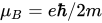


where we have added the spin dependent term from Eq. \ref{eq:hor_Hint}. indicates that the matrix element is for a magnetic dipole transition. The strength of the transition is set by


so it is indeed a factor of weaker than a dipole transition, as we argued above.
The second term in Eq.\ \ref{eq:hor4} involves .
Making use of the commutator relation , we
have

![{\displaystyle [r,H_{0}]=i\hbar p/m}](https://wikimedia.org/api/rest_v1/media/math/render/svg/ff1ce0c55d5b95d0e4b94f59cfe038fd2cf74902)
![{\displaystyle {\frac {1}{2}}(p_{z}x+zp_{x})={\frac {m}{2i\hbar }}([z,H_{0}]x+z[x,H_{0}])={\frac {m}{2i\hbar }}(-H_{0}zx+zxH_{0}).}](https://wikimedia.org/api/rest_v1/media/math/render/svg/b11f1cb83bdc50e5d639982400f2f7182dd75816)
So, the contribution of this term to is

- Failed to parse (MathML with SVG or PNG fallback (recommended for modern browsers and accessibility tools): Invalid response ("Math extension cannot connect to Restbase.") from server "https://wikimedia.org/api/rest_v1/":): {\displaystyle \frac{ieA}{mc} \frac{km}{2\hbar i} \langle b | - H_0 zx + zx H_0 | a \rangle = - \frac{eAk}{2c} \frac{E_b - E_a}{\hbar} \langle b | zx | a \rangle = \frac{ieE\omega}{2c} \langle b | zx | a \rangle, }
 where we have taken Failed to parse (MathML with SVG or PNG fallback (recommended for modern browsers and accessibility tools): Invalid response ("Math extension cannot connect to Restbase.") from server "https://wikimedia.org/api/rest_v1/":): {\displaystyle E = i k A}
.  This is an electric
 quadrupole interaction, and we shall denote the matrix element by
- Failed to parse (MathML with SVG or PNG fallback (recommended for modern browsers and accessibility tools): Invalid response ("Math extension cannot connect to Restbase.") from server "https://wikimedia.org/api/rest_v1/":): {\displaystyle H_{\rm int} (E2)^\prime = \frac{ie\omega}{2c} \langle b | zx | a \rangle E. }
The prime indicates that we are considering only one component of a
more general expression involving the matrix element Failed to parse (MathML with SVG or PNG fallback (recommended for modern browsers and accessibility tools): Invalid response ("Math extension cannot connect to Restbase.") from server "https://wikimedia.org/api/rest_v1/":): {\displaystyle \langle b |r:r|a\rangle}
of a tensor product. It is straightforward to verify that the electric quadrupole interaction is also of order .
The total matrix element of the second term in the expansion of Eq.\ \ref{eq:hor3} can be written
- Failed to parse (MathML with SVG or PNG fallback (recommended for modern browsers and accessibility tools): Invalid response ("Math extension cannot connect to Restbase.") from server "https://wikimedia.org/api/rest_v1/":): {\displaystyle H_{\rm int}^{(2)} = H_{\rm int} (M1) + H_{\rm int} (E2). }
 Note that
 Failed to parse (MathML with SVG or PNG fallback (recommended for modern browsers and accessibility tools): Invalid response ("Math extension cannot connect to Restbase.") from server "https://wikimedia.org/api/rest_v1/":): {\displaystyle H_{\rm int} (M1)}
 is
 real, whereas Failed to parse (MathML with SVG or PNG fallback (recommended for modern browsers and accessibility tools): Invalid response ("Math extension cannot connect to Restbase.") from server "https://wikimedia.org/api/rest_v1/":): {\displaystyle H_{\rm int} (E2)}
 is imaginary.  Consequently,
- Failed to parse (MathML with SVG or PNG fallback (recommended for modern browsers and accessibility tools): Invalid response ("Math extension cannot connect to Restbase.") from server "https://wikimedia.org/api/rest_v1/":): {\displaystyle | H_{\rm int}^{(2)} |^2 = | H_{\rm int} (M1)|^2 + | H_{\rm int}(E2) |^2. }
The magnetic dipole and electric quadrupole terms do not
interfere.
Because transition rates depend on , the magnetic dipole and electric quadrupole rates
are both smaller than the dipole rate by Failed to parse (MathML with SVG or PNG fallback (recommended for modern browsers and accessibility tools): Invalid response ("Math extension cannot connect to Restbase.") from server "https://wikimedia.org/api/rest_v1/":): {\displaystyle \alpha^2 \sim 5 \times 10^{-5}}
. For this reason they are generally referred to as {\it forbidden}
processes. However, the term is used somewhat loosely, for there
are transitions which are much more strongly suppressed due to other
selection rules, as for instance triplet to singlet transitions in
helium.

\begin{table}
| Transition | Operator | Parity | |
| Electric Dipole | Failed to parse (MathML with SVG or PNG fallback (recommended for modern browsers and accessibility tools): Invalid response ("Math extension cannot connect to Restbase.") from server "https://wikimedia.org/api/rest_v1/":): {\displaystyle E1} | Failed to parse (MathML with SVG or PNG fallback (recommended for modern browsers and accessibility tools): Invalid response ("Math extension cannot connect to Restbase.") from server "https://wikimedia.org/api/rest_v1/":): {\displaystyle -er} | - |
| Magnetic Dipole | Failed to parse (MathML with SVG or PNG fallback (recommended for modern browsers and accessibility tools): Invalid response ("Math extension cannot connect to Restbase.") from server "https://wikimedia.org/api/rest_v1/":): {\displaystyle M1} | + | |
| Electric Quadrupole | Failed to parse (MathML with SVG or PNG fallback (recommended for modern browsers and accessibility tools): Invalid response ("Math extension cannot connect to Restbase.") from server "https://wikimedia.org/api/rest_v1/":): {\displaystyle E2} | Failed to parse (MathML with SVG or PNG fallback (recommended for modern browsers and accessibility tools): Invalid response ("Math extension cannot connect to Restbase.") from server "https://wikimedia.org/api/rest_v1/":): {\displaystyle -er:r} | + |

\caption{Summary of dipole and higher-order radiation processes.} \end{table}
Selection rules
A forbidden transition, then, is one that is weaker than an electric dipole-allowed transition by Failed to parse (MathML with SVG or PNG fallback (recommended for modern browsers and accessibility tools): Invalid response ("Math extension cannot connect to Restbase.") from server "https://wikimedia.org/api/rest_v1/":): {\displaystyle \alpha^n} and only appears in some higher-order approximation. Examples of such higher-order effects are the magnetic dipole and electric quadrupole terms described above, multiphoton processes, the relativistic effects which allow singlet to triplet transitions in helium, and hyperfine interactions within the nucleus. To derive selection rules for the transitions we have discussed above, it is useful to express the matrix elements in terms of spherical tensor operators:
- Failed to parse (MathML with SVG or PNG fallback (recommended for modern browsers and accessibility tools): Invalid response ("Math extension cannot connect to Restbase.") from server "https://wikimedia.org/api/rest_v1/":): {\displaystyle H_{int}(T_{l,m}) = \langle n J M | T_{l,m} | n' J' M'\rangle, }
where is a spherical tensor operator of rank Failed to parse (MathML with SVG or PNG fallback (recommended for modern browsers and accessibility tools): Invalid response ("Math extension cannot connect to Restbase.") from server "https://wikimedia.org/api/rest_v1/":): {\displaystyle l} . The operators Failed to parse (MathML with SVG or PNG fallback (recommended for modern browsers and accessibility tools): Invalid response ("Math extension cannot connect to Restbase.") from server "https://wikimedia.org/api/rest_v1/":): {\displaystyle T_{l,m}} transform under rotations like the spherical harmonics Failed to parse (MathML with SVG or PNG fallback (recommended for modern browsers and accessibility tools): Invalid response ("Math extension cannot connect to Restbase.") from server "https://wikimedia.org/api/rest_v1/":): {\displaystyle Y_{l,m}} , and any operator can be written as a linear combination of these spherical tensors. By the Wigner-Eckart Theorem, we can express the matrix element


in terms of a reduced matrix element and a Clebsch-Gordan coefficient \linebreak. In order for the latter to be nonzero, the triangle rule requires that \linebreak, while conservation of angular momentum requires Failed to parse (MathML with SVG or PNG fallback (recommended for modern browsers and accessibility tools): Invalid response ("Math extension cannot connect to Restbase.") from server "https://wikimedia.org/api/rest_v1/":): {\displaystyle M = M' + m} . Since the operators Failed to parse (MathML with SVG or PNG fallback (recommended for modern browsers and accessibility tools): Invalid response ("Math extension cannot connect to Restbase.") from server "https://wikimedia.org/api/rest_v1/":): {\displaystyle er} and Failed to parse (MathML with SVG or PNG fallback (recommended for modern browsers and accessibility tools): Invalid response ("Math extension cannot connect to Restbase.") from server "https://wikimedia.org/api/rest_v1/":): {\displaystyle \mu_B B} responsible for Failed to parse (MathML with SVG or PNG fallback (recommended for modern browsers and accessibility tools): Invalid response ("Math extension cannot connect to Restbase.") from server "https://wikimedia.org/api/rest_v1/":): {\displaystyle E1} and transitions are both vectors, i.e. tensors of rank Failed to parse (MathML with SVG or PNG fallback (recommended for modern browsers and accessibility tools): Invalid response ("Math extension cannot connect to Restbase.") from server "https://wikimedia.org/api/rest_v1/":): {\displaystyle l=1} , these transitions are both governed by the dipole selection rules


- Failed to parse (MathML with SVG or PNG fallback (recommended for modern browsers and accessibility tools): Invalid response ("Math extension cannot connect to Restbase.") from server "https://wikimedia.org/api/rest_v1/":): {\displaystyle \begin{align} |\Delta J| &= 0, 1;\\ |\Delta m| &= 0, 1. \end{align}}
Since Failed to parse (MathML with SVG or PNG fallback (recommended for modern browsers and accessibility tools): Invalid response ("Math extension cannot connect to Restbase.") from server "https://wikimedia.org/api/rest_v1/":): {\displaystyle \bf r} is a polar vector and Failed to parse (MathML with SVG or PNG fallback (recommended for modern browsers and accessibility tools): Invalid response ("Math extension cannot connect to Restbase.") from server "https://wikimedia.org/api/rest_v1/":): {\displaystyle \bf L} is an axial vector, transitions are allowed only between states of opposite parity and Failed to parse (MathML with SVG or PNG fallback (recommended for modern browsers and accessibility tools): Invalid response ("Math extension cannot connect to Restbase.") from server "https://wikimedia.org/api/rest_v1/":): {\displaystyle M} transitions are allowed only between states of the same parity. The operator responsible for Failed to parse (MathML with SVG or PNG fallback (recommended for modern browsers and accessibility tools): Invalid response ("Math extension cannot connect to Restbase.") from server "https://wikimedia.org/api/rest_v1/":): {\displaystyle E2} transitions is a spherical tensor of rank 2. For example,

- Failed to parse (MathML with SVG or PNG fallback (recommended for modern browsers and accessibility tools): Invalid response ("Math extension cannot connect to Restbase.") from server "https://wikimedia.org/api/rest_v1/":): {\displaystyle xz = (T_{2,-1}-T_{2,1})/4. }
Thus, electric quadrupole transitions are allowed only between states connected by tensors Failed to parse (MathML with SVG or PNG fallback (recommended for modern browsers and accessibility tools): Invalid response ("Math extension cannot connect to Restbase.") from server "https://wikimedia.org/api/rest_v1/":): {\displaystyle T_{2,m}(r)} , requiring:

In addition, Failed to parse (MathML with SVG or PNG fallback (recommended for modern browsers and accessibility tools): Invalid response ("Math extension cannot connect to Restbase.") from server "https://wikimedia.org/api/rest_v1/":): {\displaystyle J=0\rightarrow J'=0} transitions are forbidden in all of the cases considered above, since Failed to parse (MathML with SVG or PNG fallback (recommended for modern browsers and accessibility tools): Invalid response ("Math extension cannot connect to Restbase.") from server "https://wikimedia.org/api/rest_v1/":): {\displaystyle J=J'=0} requires Failed to parse (MathML with SVG or PNG fallback (recommended for modern browsers and accessibility tools): Invalid response ("Math extension cannot connect to Restbase.") from server "https://wikimedia.org/api/rest_v1/":): {\displaystyle \Delta L=0} (for any interaction that does not couple to spin) whereas absorption or emission of a photon implies Failed to parse (MathML with SVG or PNG fallback (recommended for modern browsers and accessibility tools): Invalid response ("Math extension cannot connect to Restbase.") from server "https://wikimedia.org/api/rest_v1/":): {\displaystyle |\Delta L|=1} .
 This discussion of matrix elements, selection rules, and radiative
 processes barely skims the subject.  For an authoritative
 treatment, the books by Shore and Menzel and by Sobelman are
 recommended.
