Difference between revisions of "Atoms in electric fields"
imported>Wikibot m (New page: donewcmd error! no pattern match \newcommand{\QU}[1]{\par% = Atoms in Electric Fields = \markboth{Physics 165, Spring 2003}{Atoms in Electric Fields} This section deals with how atoms...) |
imported>Wikibot m |
||
| Line 194: | Line 194: | ||
theory taking <math>H_0</math> to describe the unperturbed atomic system and | theory taking <math>H_0</math> to describe the unperturbed atomic system and | ||
:<math> | :<math> | ||
| − | H^\prime = - d \cdot \ | + | H^\prime = - d \cdot \hat{z}\mathcal{E} = ez\mathcal{E} |
</math> | </math> | ||
As discussed in Sect.\ \ref{SEC_rp}, parity requires that | As discussed in Sect.\ \ref{SEC_rp}, parity requires that | ||
| Line 217: | Line 217: | ||
The induced dipole moment can be found from the polarization. | The induced dipole moment can be found from the polarization. | ||
:<math> | :<math> | ||
| − | d= \alpha \mathcal{E} \ | + | d= \alpha \mathcal{E} \hat{z} = 2 e^2 \mathcal{E}\hat{z} |
\sum_{m} | \sum_{m} | ||
\mbox{}^\prime \frac{| \langle m | z | n {\rangle}|^2}{E_m - E_n} | \mbox{}^\prime \frac{| \langle m | z | n {\rangle}|^2}{E_m - E_n} | ||
| Line 236: | Line 236: | ||
| z | | | z | | ||
n^{(0)} \rangle} | n^{(0)} \rangle} | ||
| − | {E_m -E_n}\right]} \ | + | {E_m -E_n}\right]} \hat{s} \cdot\hat{z} \mathcal{E} |
</math> | </math> | ||
where the sum is over <math>s = x,y,z.</math> Only the term <math>s = z</math> will | where the sum is over <math>s = x,y,z.</math> Only the term <math>s = z</math> will | ||
| Line 290: | Line 290: | ||
oscillating field | oscillating field | ||
:<math> | :<math> | ||
| − | \mathcal{E} (\omega , t) \ | + | \mathcal{E} (\omega , t) \hat{e} = \mathcal{E} \hat{e} \cos\omega |
t | t | ||
</math> | </math> | ||
| − | where <math>\ | + | where <math>\hat{e}</math> is the polarization vector for the field. For |
a weak field the time varying state | a weak field the time varying state | ||
of this system can be found from first order time dependent | of this system can be found from first order time dependent | ||
| Line 303: | Line 303: | ||
where <math>H_0</math> is the unperturbed Hamiltonian and | where <math>H_0</math> is the unperturbed Hamiltonian and | ||
:<math> | :<math> | ||
| − | H^\prime = -D \cdot \ | + | H^\prime = -D \cdot \hat{e} \mathcal{E} \cos \omega t = - |
\frac{1}{2} (e^{i\omega t} + e^{-i\omega | \frac{1}{2} (e^{i\omega t} + e^{-i\omega | ||
| − | t} ) \mathcal{E} \ | + | t} ) \mathcal{E} \hat{e} \cdot D |
</math> | </math> | ||
We shall express the solution of the time dependent Schroedinger | We shall express the solution of the time dependent Schroedinger | ||
| Line 359: | Line 359: | ||
e^{i(\omega_{kg} - \omega )t^\prime } \right]} </math></math> | e^{i(\omega_{kg} - \omega )t^\prime } \right]} </math></math> | ||
:<math> | :<math> | ||
| − | = \frac{\mathcal{E}}{2\hbar} \langle k |\ | + | = \frac{\mathcal{E}}{2\hbar} \langle k |\hat{e} \cdot D |g |
\rangle {\left[ \frac{e^{i(\omega_{kg} +\omega | \rangle {\left[ \frac{e^{i(\omega_{kg} +\omega | ||
)t}-1}{\omega_{kg} + \omega} + \frac{e^{i(\omega_{kg} - \omega | )t}-1}{\omega_{kg} + \omega} + \frac{e^{i(\omega_{kg} - \omega | ||
| Line 381: | Line 381: | ||
:<math> | :<math> | ||
= \mathcal{E} {\rm Re} {\left[ \sum_{k} \frac{ \langle g |D |k | = \mathcal{E} {\rm Re} {\left[ \sum_{k} \frac{ \langle g |D |k | ||
| − | \rangle \langle k|\ | + | \rangle \langle k|\hat{e} \cdot D |g \rangle }{\hbar} |
{\left\{ | {\left\{ | ||
\frac{e^{i\omega t }}{\omega_{kg} + \omega} + \frac{e^{-i\omega | \frac{e^{i\omega t }}{\omega_{kg} + \omega} + \frac{e^{-i\omega | ||
| Line 387: | Line 387: | ||
\right\}} \right]} | \right\}} \right]} | ||
</math> | </math> | ||
| − | If we consider the case of linearly polarized light <math>(\ | + | If we consider the case of linearly polarized light <math>(\hat{e} = |
| − | \ | + | \hat{z})</math>, then |
:<math> | :<math> | ||
d_z (\omega , t) = \frac{2e^2}{\hbar} \sum_{k} \frac{\omega_{kg} | | d_z (\omega , t) = \frac{2e^2}{\hbar} \sum_{k} \frac{\omega_{kg} | | ||
| Line 504: | Line 504: | ||
for emission of a photon is negative. | for emission of a photon is negative. | ||
Our definition of oscillator strength, Eq.\ \ref{EQ_ostre3}, | Our definition of oscillator strength, Eq.\ \ref{EQ_ostre3}, | ||
| − | singles out a particular axis, the <math>\ | + | singles out a particular axis, the <math>\hat{z}</math>-axis, fixed by the |
polarization of the light. Consequently, it depends on the orientation | polarization of the light. Consequently, it depends on the orientation | ||
of the atom in the initial state and final states. It is convenient to | of the atom in the initial state and final states. It is convenient to | ||
Revision as of 22:07, 27 February 2009
donewcmd error! no pattern match \newcommand{\QU}[1]{\par%
Contents
Atoms in Electric Fields
\markboth{Physics 165, Spring 2003}{Atoms in Electric Fields}
This section deals with how atoms behave in static electric fields. The method is straightforward, involving second order Rayleigh-Schrodinger perturbation theory. The treatment describes the effects of symmetry on the basic interaction, polarizability, and the concept of oscillator strength. Let us review the concept of parity. Parity is a consequence of space inversion.

We propose an operator that (in the spirit of the rotation operator introduced earlier) takes an initial ket and returns a ket with the above inversion operation performed.

We require that this operator in unitary and that it has the following key property (or, perhaps more precisely we define the operator through)
which implies

To put the finest point on it, Failed to parse (MathML with SVG or PNG fallback (recommended for modern browsers and accessibility tools): Invalid response ("Math extension cannot connect to Restbase.") from server "https://wikimedia.org/api/rest_v1/":): {\displaystyle \pi | x^{\prime}\rangle} is an eigenket of Failed to parse (MathML with SVG or PNG fallback (recommended for modern browsers and accessibility tools): Invalid response ("Math extension cannot connect to Restbase.") from server "https://wikimedia.org/api/rest_v1/":): {\displaystyle x} with eigenvalue of Failed to parse (MathML with SVG or PNG fallback (recommended for modern browsers and accessibility tools): Invalid response ("Math extension cannot connect to Restbase.") from server "https://wikimedia.org/api/rest_v1/":): {\displaystyle - x^{\prime}} . Finally, the eigenvalues of Failed to parse (MathML with SVG or PNG fallback (recommended for modern browsers and accessibility tools): Invalid response ("Math extension cannot connect to Restbase.") from server "https://wikimedia.org/api/rest_v1/":): {\displaystyle \pi} are and

- Failed to parse (MathML with SVG or PNG fallback (recommended for modern browsers and accessibility tools): Invalid response ("Math extension cannot connect to Restbase.") from server "https://wikimedia.org/api/rest_v1/":): {\displaystyle \pi^{-1} = \pi = \pi ^{\dagger} }
Position is "odd" under space inversion or "odd under the parity operator". Angular momentum, on the other hand is even.
- Failed to parse (MathML with SVG or PNG fallback (recommended for modern browsers and accessibility tools): Invalid response ("Math extension cannot connect to Restbase.") from server "https://wikimedia.org/api/rest_v1/":): {\displaystyle \pi^{\dagger} \vec{L} \pi = \pi^{\dagger} {\vec{x} \times \vec{p} } \pi = \vec{x} \times \vec{p} = \vec{L} }
Because of this property position and momentum are called vectors or polar vectors and angular momentum is called an axial or psuedo vector. What about wavefunction? What does the parity operator do to wavefunctions? Well it depends on the wavefunction. For example, consider the spherical harmonics (the angular part of the hydrogen atom eigenstates). Some of the wavefunctions are odd under parity and some are even. (In one dimension a cosine wave is "even" whereas a sine wave is "odd".)
- Failed to parse (MathML with SVG or PNG fallback (recommended for modern browsers and accessibility tools): Invalid response ("Math extension cannot connect to Restbase.") from server "https://wikimedia.org/api/rest_v1/":): {\displaystyle \pi | Y_l^m \rangle = (-1) ^ l | Y_l^m \rangle }
Now, consider the case where a state is an energy eigenket and the parity operator commutes with Hamiltonian. Such a ket is not necessarily an eigenket of the parity operator. Consider, for example, the case of the hydrogen atom for Failed to parse (MathML with SVG or PNG fallback (recommended for modern browsers and accessibility tools): Invalid response ("Math extension cannot connect to Restbase.") from server "https://wikimedia.org/api/rest_v1/":): {\displaystyle n=2} . Neglecting higher order pertubations to the hamiltonian, can be made up of a combination of two eigenkets with different parities,

- Failed to parse (MathML with SVG or PNG fallback (recommended for modern browsers and accessibility tools): Invalid response ("Math extension cannot connect to Restbase.") from server "https://wikimedia.org/api/rest_v1/":): {\displaystyle |n=2\rangle = a_1 | n=2, l = 0, m \rangle + a_2 | n=2, l = 1, m^{\prime} \rangle }
Without any degeneracies eigenstates of the hamiltonian are indeed eigenstates of the parity operator if the hamiltonian and Failed to parse (MathML with SVG or PNG fallback (recommended for modern browsers and accessibility tools): Invalid response ("Math extension cannot connect to Restbase.") from server "https://wikimedia.org/api/rest_v1/":): {\displaystyle \pi} commute. This idea of parity gives rise to what is called a selection rule. Selection rules, in general, are nothing more than the statement that certain operators connect certain states (Failed to parse (MathML with SVG or PNG fallback (recommended for modern browsers and accessibility tools): Invalid response ("Math extension cannot connect to Restbase.") from server "https://wikimedia.org/api/rest_v1/":): {\displaystyle \langle i | A | j \rangle \neq 0} for certain Failed to parse (MathML with SVG or PNG fallback (recommended for modern browsers and accessibility tools): Invalid response ("Math extension cannot connect to Restbase.") from server "https://wikimedia.org/api/rest_v1/":): {\displaystyle i,j} ) and do not connect other states (that is, Failed to parse (MathML with SVG or PNG fallback (recommended for modern browsers and accessibility tools): Invalid response ("Math extension cannot connect to Restbase.") from server "https://wikimedia.org/api/rest_v1/":): {\displaystyle \langle i^{\prime} | A | j^{\prime} \rangle = 0} for certain Failed to parse (MathML with SVG or PNG fallback (recommended for modern browsers and accessibility tools): Invalid response ("Math extension cannot connect to Restbase.") from server "https://wikimedia.org/api/rest_v1/":): {\displaystyle i^{\prime}, j^{\prime}} ). Consider, for example, the Failed to parse (MathML with SVG or PNG fallback (recommended for modern browsers and accessibility tools): Invalid response ("Math extension cannot connect to Restbase.") from server "https://wikimedia.org/api/rest_v1/":): {\displaystyle \vec{x}} operator and two different parity eigenstates,
- Failed to parse (MathML with SVG or PNG fallback (recommended for modern browsers and accessibility tools): Invalid response ("Math extension cannot connect to Restbase.") from server "https://wikimedia.org/api/rest_v1/":): {\displaystyle \pi|\alpha\rangle = p_\alpha |\alpha \rangle ~~~ \pi |\beta\rangle = p_\beta | \beta \rangle ~~~ p_{\alpha, \beta} = \pm 1 }
then
- Failed to parse (MathML with SVG or PNG fallback (recommended for modern browsers and accessibility tools): Invalid response ("Math extension cannot connect to Restbase.") from server "https://wikimedia.org/api/rest_v1/":): {\displaystyle \langle \beta | \vec{x} | \alpha \rangle = 0 ~{\rm unless}~ p_\alpha = - p_\beta }
One can see this in the following way

which can be true only if Failed to parse (MathML with SVG or PNG fallback (recommended for modern browsers and accessibility tools): Invalid response ("Math extension cannot connect to Restbase.") from server "https://wikimedia.org/api/rest_v1/":): {\displaystyle p_\alpha p_\beta = -1} . Failed to parse (MathML with SVG or PNG fallback (recommended for modern browsers and accessibility tools): Invalid response ("Math extension cannot connect to Restbase.") from server "https://wikimedia.org/api/rest_v1/":): {\displaystyle \vec{x}} is an "parity odd operator" and it connects states of opposite parity. "Even operators" connect states of the same parity.
Atoms in a Static Electric Field
We can use this basic idea in understanding the problem of an atom subjected to an electric field. We begin by writing down the potential due to a collection of charges,
- Failed to parse (MathML with SVG or PNG fallback (recommended for modern browsers and accessibility tools): Invalid response ("Math extension cannot connect to Restbase.") from server "https://wikimedia.org/api/rest_v1/":): {\displaystyle \Phi(\vec{x} ) = \Sigma_{l=0}^{\infty} \Sigma_{m=-l}^{l} q_{lm} Y^m_{lm} (\theta, \phi) \frac{C}{r^{l+1}} }
where
- Failed to parse (MathML with SVG or PNG fallback (recommended for modern browsers and accessibility tools): Invalid response ("Math extension cannot connect to Restbase.") from server "https://wikimedia.org/api/rest_v1/":): {\displaystyle q_{lm} \equiv \int Y_l^{m*} r^l \rho(\vec{x}) d^3 x }
where is the charge distribution. Failed to parse (MathML with SVG or PNG fallback (recommended for modern browsers and accessibility tools): Invalid response ("Math extension cannot connect to Restbase.") from server "https://wikimedia.org/api/rest_v1/":): {\displaystyle q_{00}} is the total charge, Failed to parse (MathML with SVG or PNG fallback (recommended for modern browsers and accessibility tools): Invalid response ("Math extension cannot connect to Restbase.") from server "https://wikimedia.org/api/rest_v1/":): {\displaystyle q_{1x}} are the dipole moments, Failed to parse (MathML with SVG or PNG fallback (recommended for modern browsers and accessibility tools): Invalid response ("Math extension cannot connect to Restbase.") from server "https://wikimedia.org/api/rest_v1/":): {\displaystyle q_{2x}} are the quadrupole moments, etc. The energy Failed to parse (MathML with SVG or PNG fallback (recommended for modern browsers and accessibility tools): Invalid response ("Math extension cannot connect to Restbase.") from server "https://wikimedia.org/api/rest_v1/":): {\displaystyle U} of an overall neutral collection of charges in an electric field can similarly be expanded as


- Failed to parse (MathML with SVG or PNG fallback (recommended for modern browsers and accessibility tools): Invalid response ("Math extension cannot connect to Restbase.") from server "https://wikimedia.org/api/rest_v1/":): {\displaystyle U = -\vec{d} \cdot \hat{z} \mathcal{E} - \frac{1}{2} \alpha \mathcal{E}^2 + O(\mathcal{E}^3) + ... }
where Failed to parse (MathML with SVG or PNG fallback (recommended for modern browsers and accessibility tools): Invalid response ("Math extension cannot connect to Restbase.") from server "https://wikimedia.org/api/rest_v1/":): {\displaystyle d} is the dipole and Failed to parse (MathML with SVG or PNG fallback (recommended for modern browsers and accessibility tools): Invalid response ("Math extension cannot connect to Restbase.") from server "https://wikimedia.org/api/rest_v1/":): {\displaystyle \alpha} is the polarizability. Now we are in a better position to solve the problem of the hydrogen atom in a static electric field, Failed to parse (MathML with SVG or PNG fallback (recommended for modern browsers and accessibility tools): Invalid response ("Math extension cannot connect to Restbase.") from server "https://wikimedia.org/api/rest_v1/":): {\displaystyle \vec{\mathcal{E}} = \mathcal{E} \hat{z}} , just about the simplest example. The hamiltonian for this problem can be written

where Failed to parse (MathML with SVG or PNG fallback (recommended for modern browsers and accessibility tools): Invalid response ("Math extension cannot connect to Restbase.") from server "https://wikimedia.org/api/rest_v1/":): {\displaystyle H_0} is the "unperturbed" hamiltonian for the hydrogen atom. We chose to solve this via matrix methods. The first step is to write down the matrix elements for the hamiltonian is a basis of our choosing. Let's try with the Failed to parse (MathML with SVG or PNG fallback (recommended for modern browsers and accessibility tools): Invalid response ("Math extension cannot connect to Restbase.") from server "https://wikimedia.org/api/rest_v1/":): {\displaystyle |nlm\rangle} basis kets, the eigenkets of Failed to parse (MathML with SVG or PNG fallback (recommended for modern browsers and accessibility tools): Invalid response ("Math extension cannot connect to Restbase.") from server "https://wikimedia.org/api/rest_v1/":): {\displaystyle H_0} . So, Failed to parse (MathML with SVG or PNG fallback (recommended for modern browsers and accessibility tools): Invalid response ("Math extension cannot connect to Restbase.") from server "https://wikimedia.org/api/rest_v1/":): {\displaystyle H_0} only contributes diagonal elements to the matrix, . As Failed to parse (MathML with SVG or PNG fallback (recommended for modern browsers and accessibility tools): Invalid response ("Math extension cannot connect to Restbase.") from server "https://wikimedia.org/api/rest_v1/":): {\displaystyle e} and Failed to parse (MathML with SVG or PNG fallback (recommended for modern browsers and accessibility tools): Invalid response ("Math extension cannot connect to Restbase.") from server "https://wikimedia.org/api/rest_v1/":): {\displaystyle E} are scalars, not operators, we need only consider the effect of Failed to parse (MathML with SVG or PNG fallback (recommended for modern browsers and accessibility tools): Invalid response ("Math extension cannot connect to Restbase.") from server "https://wikimedia.org/api/rest_v1/":): {\displaystyle z} . First, Failed to parse (MathML with SVG or PNG fallback (recommended for modern browsers and accessibility tools): Invalid response ("Math extension cannot connect to Restbase.") from server "https://wikimedia.org/api/rest_v1/":): {\displaystyle z} is a parity odd operator, connecting only states of different parity. Thus contributes nothing to the diagonal entries nor to any entries with the same angular momentum, Failed to parse (MathML with SVG or PNG fallback (recommended for modern browsers and accessibility tools): Invalid response ("Math extension cannot connect to Restbase.") from server "https://wikimedia.org/api/rest_v1/":): {\displaystyle l} . States of the same parity but whose angular momentum differ by more than Failed to parse (MathML with SVG or PNG fallback (recommended for modern browsers and accessibility tools): Invalid response ("Math extension cannot connect to Restbase.") from server "https://wikimedia.org/api/rest_v1/":): {\displaystyle \Delta l = \pm 1} also result in zero because ... Finally, also only connects states of the same . One can see this by noting that


which is an even function in . Any states differing by would then result in an integral of two even functions (one of those being the Failed to parse (MathML with SVG or PNG fallback (recommended for modern browsers and accessibility tools): Invalid response ("Math extension cannot connect to Restbase.") from server "https://wikimedia.org/api/rest_v1/":): {\displaystyle \cos \theta} originating from the Failed to parse (MathML with SVG or PNG fallback (recommended for modern browsers and accessibility tools): Invalid response ("Math extension cannot connect to Restbase.") from server "https://wikimedia.org/api/rest_v1/":): {\displaystyle z} ) and an odd function in Failed to parse (MathML with SVG or PNG fallback (recommended for modern browsers and accessibility tools): Invalid response ("Math extension cannot connect to Restbase.") from server "https://wikimedia.org/api/rest_v1/":): {\displaystyle \theta} which is zero. This resulta can also be seen directly by noting a result of the Wigner-Eckhart theorem that Failed to parse (MathML with SVG or PNG fallback (recommended for modern browsers and accessibility tools): Invalid response ("Math extension cannot connect to Restbase.") from server "https://wikimedia.org/api/rest_v1/":): {\displaystyle \langle njm|z|njm^{\prime} \rangle= \alpha(n,j) \langle njm | J_z| njm^{\prime} \rangle } where is just a number. Thus, we produce the "selection rules" for the Failed to parse (MathML with SVG or PNG fallback (recommended for modern browsers and accessibility tools): Invalid response ("Math extension cannot connect to Restbase.") from server "https://wikimedia.org/api/rest_v1/":): {\displaystyle \vec{E} = E \hat{z}} operator,


- Failed to parse (MathML with SVG or PNG fallback (recommended for modern browsers and accessibility tools): Invalid response ("Math extension cannot connect to Restbase.") from server "https://wikimedia.org/api/rest_v1/":): {\displaystyle \Delta m = 0 ~~~~ \ l = \pm 1 }
NOTE that this strictly applies only the this specific operator. If Failed to parse (MathML with SVG or PNG fallback (recommended for modern browsers and accessibility tools): Invalid response ("Math extension cannot connect to Restbase.") from server "https://wikimedia.org/api/rest_v1/":): {\displaystyle E} were pointing in some other direction then things might (and do) change. The matrix for the our hamiltonian reads then
- Failed to parse (MathML with SVG or PNG fallback (recommended for modern browsers and accessibility tools): Invalid response ("Math extension cannot connect to Restbase.") from server "https://wikimedia.org/api/rest_v1/":): {\displaystyle \begin{pmatrix} E_1 & 0(e/o) & 0(e/o) & eE\langle z \rangle & 0(p) & ... \\ ~ & E _ 2 & 0(p) & 0(p) & 0(p) & ~ \\ ~ & ~ & E_2 & 0(p) & 0(e/o) & ~ \\ ~ &~ & ~ & E_2 & eE\langle z \rangle & ~ \\ ~ & ~ & ~ & ~ & E_2 & ~ \end{pmatrix} }
where the entries arranged in order. The 0's are designated with an indication of "why" those particular entries in the matrix are zero, Failed to parse (MathML with SVG or PNG fallback (recommended for modern browsers and accessibility tools): Invalid response ("Math extension cannot connect to Restbase.") from server "https://wikimedia.org/api/rest_v1/":): {\displaystyle e/o} meaning even/odd (Failed to parse (MathML with SVG or PNG fallback (recommended for modern browsers and accessibility tools): Invalid response ("Math extension cannot connect to Restbase.") from server "https://wikimedia.org/api/rest_v1/":): {\displaystyle \Delta m = 0} selection rule) and Failed to parse (MathML with SVG or PNG fallback (recommended for modern browsers and accessibility tools): Invalid response ("Math extension cannot connect to Restbase.") from server "https://wikimedia.org/api/rest_v1/":): {\displaystyle p} meaning parity (Failed to parse (MathML with SVG or PNG fallback (recommended for modern browsers and accessibility tools): Invalid response ("Math extension cannot connect to Restbase.") from server "https://wikimedia.org/api/rest_v1/":): {\displaystyle \Delta l = \pm 1} selection rule. As mentioned above, the contribution to the diagonal elements is zero due to parity. Because the Failed to parse (MathML with SVG or PNG fallback (recommended for modern browsers and accessibility tools): Invalid response ("Math extension cannot connect to Restbase.") from server "https://wikimedia.org/api/rest_v1/":): {\displaystyle n=2} states are degenerate, degenerate pertubation theory must be used to solve the problem. Of course we know that in reality the problem is more complex than this. Both fine, hyperfine and the Lamb shift have been neglected. Solving the problem taking this into account would indicate the use of second order pertubation theory. To see how this all shakes out, let's go ahead and apply pertubation theory directly.

- Failed to parse (MathML with SVG or PNG fallback (recommended for modern browsers and accessibility tools): Invalid response ("Math extension cannot connect to Restbase.") from server "https://wikimedia.org/api/rest_v1/":): {\displaystyle \begin{array}{rcl} E_n^{(1)}&=&\langle n | H^{\prime} | n \rangle = 0 ~ by ~ parity \\ E_n^{(2)}&=&\Sigma_{m, m \neq n} \frac{| \langle n | H^{\prime} | m \rangle | ^ 2}{E_n - E_m} =e^2\mathcal{E}^2 \Sigma_{m, m \neq n} \frac{| \langle n | z | m \rangle | ^ 2}{E_n - E_m} \\ |n^{(1)} \rangle&=&\Sigma_{m, m \neq n} | m \rangle \frac{| \langle n | H^{\prime} | m \rangle | ^ 2}{E_n - E_m} \end{array}}
If one is in the case where this simple pertubation theory does not work because of degenerate states (leading to Failed to parse (MathML with SVG or PNG fallback (recommended for modern browsers and accessibility tools): Invalid response ("Math extension cannot connect to Restbase.") from server "https://wikimedia.org/api/rest_v1/":): {\displaystyle E_m - E_n = 0} in the denominator then it is best just to diagonalize the Hamiltonian in relation to Failed to parse (MathML with SVG or PNG fallback (recommended for modern browsers and accessibility tools): Invalid response ("Math extension cannot connect to Restbase.") from server "https://wikimedia.org/api/rest_v1/":): {\displaystyle H^{\prime}} . If you do that for the case of you find that the eigenstates are

- Failed to parse (MathML with SVG or PNG fallback (recommended for modern browsers and accessibility tools): Invalid response ("Math extension cannot connect to Restbase.") from server "https://wikimedia.org/api/rest_v1/":): {\displaystyle \begin{array}{rcl} | n=2, l=1, m=1 \rangle &~~~ & E_2\\ |2,1,-1 \rangle & ~~~& E_2\\ \frac{1}{\sqrt{2}} ( |2,1,0\rangle + |2,0,0\rangle )&~~~& E_2 + cE\\ \frac{1}{\sqrt{2}} ( |2,1,0\rangle - |2,0,0\rangle ) &~~~& E_2 -cE \end{array}}
where Failed to parse (MathML with SVG or PNG fallback (recommended for modern browsers and accessibility tools): Invalid response ("Math extension cannot connect to Restbase.") from server "https://wikimedia.org/api/rest_v1/":): {\displaystyle c} is a constant. The last two states have a linear response to the electric field, or a linear Stark effect. Even is there were a small splitting between the different states in the Failed to parse (MathML with SVG or PNG fallback (recommended for modern browsers and accessibility tools): Invalid response ("Math extension cannot connect to Restbase.") from server "https://wikimedia.org/api/rest_v1/":): {\displaystyle n=2} manifold, if the field interaction were higher that the splitting then there would be also be a linear Stark effect. At lower fields the interaction would be second order (second order pertubation theory would be called for) and the response would be quadratic in the applied electric field. Notice the the new eigenstates are a mixture of states of different parity. This mixture allows for a dipole to be formed and it is the interaction of the electic field with this dipole that gives rise to a linear response to the field. It is this dipole that is talked about by chemists when they say that a molecule "has a dipole moment". Molecules "have dipole moments" because they have closely lying states of opposite parity so small fields put them in the linear Stark regime. But make no mistake, at low enough fields, the response would be quadratic, just as it is in the case of atoms. Now, all of this has been talked about under the (essentially correct) assumption that Failed to parse (MathML with SVG or PNG fallback (recommended for modern browsers and accessibility tools): Invalid response ("Math extension cannot connect to Restbase.") from server "https://wikimedia.org/api/rest_v1/":): {\displaystyle [H, \pi ] = 0 } and, therefore, that the eigenstates of the H atom are also parity eigenstates. But what if ? This occurs when the weak force is involved and will likely be present in nature and described, eventually, by extensions to the Standard Model. Such mechanisms can lead to the presence of permanent electic dipole moments of elementary particles.
![{\displaystyle [H,\pi ]\neq 0}](https://wikimedia.org/api/rest_v1/media/math/render/svg/cdb19cc8d69e390bef7de1f0970c8d5bb991b618)
Some Results of Stationary Perturbation Theory
For reference, we recapitulate some elementary results from perturbation theory. Assume that the Hamiltonian of a system may be written as the sum of two parts
- Failed to parse (MathML with SVG or PNG fallback (recommended for modern browsers and accessibility tools): Invalid response ("Math extension cannot connect to Restbase.") from server "https://wikimedia.org/api/rest_v1/":): {\displaystyle H = H_0 + H^\prime }
and that the eigenstates and eigenvalues of Failed to parse (MathML with SVG or PNG fallback (recommended for modern browsers and accessibility tools): Invalid response ("Math extension cannot connect to Restbase.") from server "https://wikimedia.org/api/rest_v1/":): {\displaystyle H_0} are known:
- Failed to parse (MathML with SVG or PNG fallback (recommended for modern browsers and accessibility tools): Invalid response ("Math extension cannot connect to Restbase.") from server "https://wikimedia.org/api/rest_v1/":): {\displaystyle H_0 | n^{(0)} \rangle = E_n^{(0)} | n^{(0)} {\rangle} }
If it is not possible to find the eigenvalues of Failed to parse (MathML with SVG or PNG fallback (recommended for modern browsers and accessibility tools): Invalid response ("Math extension cannot connect to Restbase.") from server "https://wikimedia.org/api/rest_v1/":): {\displaystyle H} exactly, it is possible to write power series expressions for them that converge over some interval. If is time independent, the problem is stationary and the appropriate perturbation theory is Rayleigh- Schrodinger stationary state perturbation theory, described in most texts in quantum mechanics. We write
- Failed to parse (MathML with SVG or PNG fallback (recommended for modern browsers and accessibility tools): Invalid response ("Math extension cannot connect to Restbase.") from server "https://wikimedia.org/api/rest_v1/":): {\displaystyle E_n = E_n^{(0)} + E_n^{(1)} + E_n^{(2)} + \cdots }
- Failed to parse (MathML with SVG or PNG fallback (recommended for modern browsers and accessibility tools): Invalid response ("Math extension cannot connect to Restbase.") from server "https://wikimedia.org/api/rest_v1/":): {\displaystyle | n \rangle = | n^{(0)} \rangle + | n^{(1)} \rangle + \cdots }
and express the Failed to parse (MathML with SVG or PNG fallback (recommended for modern browsers and accessibility tools): Invalid response ("Math extension cannot connect to Restbase.") from server "https://wikimedia.org/api/rest_v1/":): {\displaystyle (i+1)^{\rm th}} order perturbation in terms of Failed to parse (MathML with SVG or PNG fallback (recommended for modern browsers and accessibility tools): Invalid response ("Math extension cannot connect to Restbase.") from server "https://wikimedia.org/api/rest_v1/":): {\displaystyle E^{(i)}} and . The energies are given by

- Failed to parse (MathML with SVG or PNG fallback (recommended for modern browsers and accessibility tools): Invalid response ("Math extension cannot connect to Restbase.") from server "https://wikimedia.org/api/rest_v1/":): {\displaystyle E_n^{(m)} = \langle n^{(0)} | H^\prime | n^{(m-1)} {\rangle} }
We shall only use the lowest two orders here. The first order results are
- Failed to parse (MathML with SVG or PNG fallback (recommended for modern browsers and accessibility tools): Invalid response ("Math extension cannot connect to Restbase.") from server "https://wikimedia.org/api/rest_v1/":): {\displaystyle E_n^{(1)} = \langle n | H | n{\rangle} }
- Failed to parse (MathML with SVG or PNG fallback (recommended for modern browsers and accessibility tools): Invalid response ("Math extension cannot connect to Restbase.") from server "https://wikimedia.org/api/rest_v1/":): {\displaystyle | n^{(1)} \rangle = \sum_{m} \mbox{}^\prime \frac{| m \rangle \langle m | H^\prime | n {\rangle}}{E_n - E_m} }
The symbol Failed to parse (MathML with SVG or PNG fallback (recommended for modern browsers and accessibility tools): Invalid response ("Math extension cannot connect to Restbase.") from server "https://wikimedia.org/api/rest_v1/":): {\displaystyle \sum^\prime} indicates that the term is excluded. It is understood that the sum extends over continuum states. Note that the state function is nor properly normalized, but that the error is quadratic in Failed to parse (MathML with SVG or PNG fallback (recommended for modern browsers and accessibility tools): Invalid response ("Math extension cannot connect to Restbase.") from server "https://wikimedia.org/api/rest_v1/":): {\displaystyle H^\prime} . The second order results are Failed to parse (MathML with SVG or PNG fallback (recommended for modern browsers and accessibility tools): Invalid response ("Math extension cannot connect to Restbase.") from server "https://wikimedia.org/api/rest_v1/":): {\displaystyle <math> E_n^{(2)} = \sum_{n} \mbox{}^\prime \frac{ | \langle m | H^\prime | n {\rangle} |^2}{E_n - E_m} } </math>

- Failed to parse (MathML with SVG or PNG fallback (recommended for modern browsers and accessibility tools): Invalid response ("Math extension cannot connect to Restbase.") from server "https://wikimedia.org/api/rest_v1/":): {\displaystyle | n^{(2)} {\rangle}= \sum_{m} \mbox{}^\prime | m \rangle {\left[\frac{ \langle m | H^\prime | n {\rangle}}{E_n-E_m}{\left[1-\frac{ \langle n| H^\prime | n {\rangle}}{E_n - E_m} \right]} + \sum_{p} \mbox{}^\prime \frac{ \langle m| H^\prime | p \rangle \langle p | H^\prime | n {\rangle}}{(E_n -E_m)(E_n-E_p)}\right]} }
In second order perturbation theory the effect of a coupling of Failed to parse (MathML with SVG or PNG fallback (recommended for modern browsers and accessibility tools): Invalid response ("Math extension cannot connect to Restbase.") from server "https://wikimedia.org/api/rest_v1/":): {\displaystyle n} and by is to push the levels apart, independent of the value of . Consequently, states coupled by always repel each other.

Perturbation Theory of Polarizability
We turn now to finding the energy and polarizability of an atom in a static field along the +z direction. We apply perturbation theory taking to describe the unperturbed atomic system and

- Failed to parse (MathML with SVG or PNG fallback (recommended for modern browsers and accessibility tools): Invalid response ("Math extension cannot connect to Restbase.") from server "https://wikimedia.org/api/rest_v1/":): {\displaystyle H^\prime = - d \cdot \hat{z}\mathcal{E} = ez\mathcal{E} }
As discussed in Sect.\ \ref{SEC_rp}, parity requires that Failed to parse (MathML with SVG or PNG fallback (recommended for modern browsers and accessibility tools): Invalid response ("Math extension cannot connect to Restbase.") from server "https://wikimedia.org/api/rest_v1/":): {\displaystyle H_{mm}^\prime = 0} so the first order perturbation vanishes. To second order, the energy is given by
- Failed to parse (MathML with SVG or PNG fallback (recommended for modern browsers and accessibility tools): Invalid response ("Math extension cannot connect to Restbase.") from server "https://wikimedia.org/api/rest_v1/":): {\displaystyle E_n = E_n^{(0)} - e^2 \mathcal{E}^2 \sum_{m} \mbox{}^\prime \frac{| {\langle} m | z| n \rangle |^2}{E_m - E_n} }
If we compare this results with the potential energy of a charge distribution interacting with an electric field, (Eq.\ \ref{EQ_aefone}), we can identify the polarizability interaction with the second term in this equation. As a result the polarizability in state Failed to parse (MathML with SVG or PNG fallback (recommended for modern browsers and accessibility tools): Invalid response ("Math extension cannot connect to Restbase.") from server "https://wikimedia.org/api/rest_v1/":): {\displaystyle n} is given by
- Failed to parse (syntax error): {\displaystyle \alpha_n = 2e^2 \sum_{m} \mbox{}^\prime \frac{| \langle m| z | n {\rangle}|^2}{E_m - E_n} }
Note that this has the dimensions of lengthFailed to parse (MathML with SVG or PNG fallback (recommended for modern browsers and accessibility tools): Invalid response ("Math extension cannot connect to Restbase.") from server "https://wikimedia.org/api/rest_v1/":): {\displaystyle ^3} , i.e. volume. The induced dipole moment can be found from the polarization.
- Failed to parse (MathML with SVG or PNG fallback (recommended for modern browsers and accessibility tools): Invalid response ("Math extension cannot connect to Restbase.") from server "https://wikimedia.org/api/rest_v1/":): {\displaystyle d= \alpha \mathcal{E} \hat{z} = 2 e^2 \mathcal{E}\hat{z} \sum_{m} \mbox{}^\prime \frac{| \langle m | z | n {\rangle}|^2}{E_m - E_n} }
An alternative way to calculate the dipole moment is to calculate the expectation value of the dipole operator, Eq.\ \ref{EQ_aefthree}, using the first order perturbed state vector.
- Failed to parse (MathML with SVG or PNG fallback (recommended for modern browsers and accessibility tools): Invalid response ("Math extension cannot connect to Restbase.") from server "https://wikimedia.org/api/rest_v1/":): {\displaystyle d_{nm} = (\langle n^{(0)} | + \langle n^{(1)} | ) \; {\bf d}\; ( | n^{(0)} \rangle + | n^{(1)} \rangle ) }
- Failed to parse (MathML with SVG or PNG fallback (recommended for modern browsers and accessibility tools): Invalid response ("Math extension cannot connect to Restbase.") from server "https://wikimedia.org/api/rest_v1/":): {\displaystyle = 2{\rm Re} [\langle n^{(0)} | d | n^{(1)} \rangle] =2e^2{\rm Re} {\left[ \sum_{s,m} \frac{\langle n^{(0)} | s | m \rangle \langle m | z | n^{(0)} \rangle} {E_m -E_n}\right]} \hat{s} \cdot\hat{z} \mathcal{E} }
where the sum is over Only the term Failed to parse (MathML with SVG or PNG fallback (recommended for modern browsers and accessibility tools): Invalid response ("Math extension cannot connect to Restbase.") from server "https://wikimedia.org/api/rest_v1/":): {\displaystyle s = z} will contribute, and it will yield an interaction energy in agreement with Eq.\ \ref{EQ_polartwo}. As an example, for the ground state of hydrogen we can obtain a lower limit for the polarizability by considering only the contribution to the sum of the Failed to parse (MathML with SVG or PNG fallback (recommended for modern browsers and accessibility tools): Invalid response ("Math extension cannot connect to Restbase.") from server "https://wikimedia.org/api/rest_v1/":): {\displaystyle 2P} state. Values for the various moments in hydrogen are given in Bethe and Salpeter, Section 63. Using Failed to parse (MathML with SVG or PNG fallback (recommended for modern browsers and accessibility tools): Invalid response ("Math extension cannot connect to Restbase.") from server "https://wikimedia.org/api/rest_v1/":): {\displaystyle | \langle 2P | r | 1S \rangle |^2} = 1.666, and Failed to parse (MathML with SVG or PNG fallback (recommended for modern browsers and accessibility tools): Invalid response ("Math extension cannot connect to Restbase.") from server "https://wikimedia.org/api/rest_v1/":): {\displaystyle E_{2p}- E_{1S}= 3/8} , we obtain atomic units (i.e. Failed to parse (MathML with SVG or PNG fallback (recommended for modern browsers and accessibility tools): Invalid response ("Math extension cannot connect to Restbase.") from server "https://wikimedia.org/api/rest_v1/":): {\displaystyle 2.96 \; a_0^3} ). The polarizability of the ground state of hydrogen can be calculated exactly. It turns out that the Failed to parse (MathML with SVG or PNG fallback (recommended for modern browsers and accessibility tools): Invalid response ("Math extension cannot connect to Restbase.") from server "https://wikimedia.org/api/rest_v1/":): {\displaystyle 2P} state makes the major contribution, and that the higher bound states contribute relatively little. However, the continuum makes a significant contributions. The exact value is 4.5. To put this polarizability in perspective, note that the potential of a conducting sphere of radius Failed to parse (MathML with SVG or PNG fallback (recommended for modern browsers and accessibility tools): Invalid response ("Math extension cannot connect to Restbase.") from server "https://wikimedia.org/api/rest_v1/":): {\displaystyle R} in a uniform electric field Failed to parse (MathML with SVG or PNG fallback (recommended for modern browsers and accessibility tools): Invalid response ("Math extension cannot connect to Restbase.") from server "https://wikimedia.org/api/rest_v1/":): {\displaystyle \mathcal{E} } is given by


- Failed to parse (MathML with SVG or PNG fallback (recommended for modern browsers and accessibility tools): Invalid response ("Math extension cannot connect to Restbase.") from server "https://wikimedia.org/api/rest_v1/":): {\displaystyle V(r,\theta ) = -\mathcal{E} \cos \theta \left( r - \frac{R^3}{r^2} \right) \ (r\geq R) }
The induced dipole moment is , so that the polarizability is Failed to parse (MathML with SVG or PNG fallback (recommended for modern browsers and accessibility tools): Invalid response ("Math extension cannot connect to Restbase.") from server "https://wikimedia.org/api/rest_v1/":): {\displaystyle R^3} . For the ground state of hydrogen, Failed to parse (MathML with SVG or PNG fallback (recommended for modern browsers and accessibility tools): Invalid response ("Math extension cannot connect to Restbase.") from server "https://wikimedia.org/api/rest_v1/":): {\displaystyle \bar{r}^3 = 2.75} , so to a crude approximation, in an electric field hydrogen behaves like a conducting sphere. Polarizability may be approximated easily, though not accurately, using Unsold's approximation in which the energy term in the denominator of Eq.\ \ref{EQ_polarsix} is replaced by an average energy interval Failed to parse (MathML with SVG or PNG fallback (recommended for modern browsers and accessibility tools): Invalid response ("Math extension cannot connect to Restbase.") from server "https://wikimedia.org/api/rest_v1/":): {\displaystyle \overline{E_m} -E_n} . The sum can then be evaluated using the closure rule Failed to parse (MathML with SVG or PNG fallback (recommended for modern browsers and accessibility tools): Invalid response ("Math extension cannot connect to Restbase.") from server "https://wikimedia.org/api/rest_v1/":): {\displaystyle \sum_{m} | m \rangle \langle m | =1} . (Note that the term does not need to be excluded from the sum, since Failed to parse (MathML with SVG or PNG fallback (recommended for modern browsers and accessibility tools): Invalid response ("Math extension cannot connect to Restbase.") from server "https://wikimedia.org/api/rest_v1/":): {\displaystyle \langle n | z | n \rangle = 0} .). With this approximation,

- Failed to parse (MathML with SVG or PNG fallback (recommended for modern browsers and accessibility tools): Invalid response ("Math extension cannot connect to Restbase.") from server "https://wikimedia.org/api/rest_v1/":): {\displaystyle a_n = \frac{2e^2}{\overline{E_m} - E_n} \sum_{m} \langle n |z|m \rangle \langle m|z|n{\rangle}=\frac{2e^2 \langle n|z^2|n{\rangle}}{\overline{E_m}-E_n} }
For hydrogen in the ground state, Failed to parse (MathML with SVG or PNG fallback (recommended for modern browsers and accessibility tools): Invalid response ("Math extension cannot connect to Restbase.") from server "https://wikimedia.org/api/rest_v1/":): {\displaystyle \overline{z^2} = 1} . If we take the average excitation energy to be Failed to parse (MathML with SVG or PNG fallback (recommended for modern browsers and accessibility tools): Invalid response ("Math extension cannot connect to Restbase.") from server "https://wikimedia.org/api/rest_v1/":): {\displaystyle \overline{E_m} = 0} , the result is .

Atoms in an Oscillating Electric Field
There is a close connection between the behavior of an atom in a static electric field and its response to an oscillating field, i.e. a connection between the Stark effect and radiation processes. In the former case, the field induces a static dipole moment; in the latter case, it induces an oscillating moment. An oscillating moment creates an oscillating macroscopic polarization and leads to the absorption and emission of radiation. We shall calculate the response of an atom to an oscillating field
- Failed to parse (MathML with SVG or PNG fallback (recommended for modern browsers and accessibility tools): Invalid response ("Math extension cannot connect to Restbase.") from server "https://wikimedia.org/api/rest_v1/":): {\displaystyle \mathcal{E} (\omega , t) \hat{e} = \mathcal{E} \hat{e} \cos\omega t }
where Failed to parse (MathML with SVG or PNG fallback (recommended for modern browsers and accessibility tools): Invalid response ("Math extension cannot connect to Restbase.") from server "https://wikimedia.org/api/rest_v1/":): {\displaystyle \hat{e}} is the polarization vector for the field. For a weak field the time varying state of this system can be found from first order time dependent perturbation theory. We shall write the electric dipole operator as D = -er. (This is a change of notation. Previously the symbol was d.) The Hamiltonian naturally separates into two parts, Failed to parse (MathML with SVG or PNG fallback (recommended for modern browsers and accessibility tools): Invalid response ("Math extension cannot connect to Restbase.") from server "https://wikimedia.org/api/rest_v1/":): {\displaystyle H= H_0 + H^\prime (t)} , where Failed to parse (MathML with SVG or PNG fallback (recommended for modern browsers and accessibility tools): Invalid response ("Math extension cannot connect to Restbase.") from server "https://wikimedia.org/api/rest_v1/":): {\displaystyle H_0} is the unperturbed Hamiltonian and

We shall express the solution of the time dependent Schroedinger equation in terms of the eigenstates of Failed to parse (MathML with SVG or PNG fallback (recommended for modern browsers and accessibility tools): Invalid response ("Math extension cannot connect to Restbase.") from server "https://wikimedia.org/api/rest_v1/":): {\displaystyle H_0 , |n \rangle } .
- Failed to parse (MathML with SVG or PNG fallback (recommended for modern browsers and accessibility tools): Invalid response ("Math extension cannot connect to Restbase.") from server "https://wikimedia.org/api/rest_v1/":): {\displaystyle | \psi \rangle = \sum_{n} a_n e^{-i\omega_n t} | n \rangle ~~~H_0 |\psi \rangle = \hbar \sum_{n} a_n \omega_n e^{-i\omega_n t} |n \rangle }
where Failed to parse (MathML with SVG or PNG fallback (recommended for modern browsers and accessibility tools): Invalid response ("Math extension cannot connect to Restbase.") from server "https://wikimedia.org/api/rest_v1/":): {\displaystyle \omega_n = E_n/\hbar} . Because of the perturbation Failed to parse (MathML with SVG or PNG fallback (recommended for modern browsers and accessibility tools): Invalid response ("Math extension cannot connect to Restbase.") from server "https://wikimedia.org/api/rest_v1/":): {\displaystyle H^\prime (t)} , the Failed to parse (MathML with SVG or PNG fallback (recommended for modern browsers and accessibility tools): Invalid response ("Math extension cannot connect to Restbase.") from server "https://wikimedia.org/api/rest_v1/":): {\displaystyle a_n} 's become time dependent, and we have

Left multiplying the final two expressions by Failed to parse (MathML with SVG or PNG fallback (recommended for modern browsers and accessibility tools): Invalid response ("Math extension cannot connect to Restbase.") from server "https://wikimedia.org/api/rest_v1/":): {\displaystyle \langle k|} to project out the Failed to parse (MathML with SVG or PNG fallback (recommended for modern browsers and accessibility tools): Invalid response ("Math extension cannot connect to Restbase.") from server "https://wikimedia.org/api/rest_v1/":): {\displaystyle k} -th terms yields
- Failed to parse (MathML with SVG or PNG fallback (recommended for modern browsers and accessibility tools): Invalid response ("Math extension cannot connect to Restbase.") from server "https://wikimedia.org/api/rest_v1/":): {\displaystyle \dot{a}_k = (i\hbar )^{-1} \sum_{n} \langle k | H^\prime (t) |n \rangle a_n e^{i\omega_{kn} t} }
where Failed to parse (MathML with SVG or PNG fallback (recommended for modern browsers and accessibility tools): Invalid response ("Math extension cannot connect to Restbase.") from server "https://wikimedia.org/api/rest_v1/":): {\displaystyle \omega_{kn} = \omega_k - \omega_n} . In perturbation theory, this set of equations is solved by a set of approximations to labeled . Starting with


one sets

and solves for the successive approximations by integration. We now apply this to the problem of an atom which is in its ground state at Failed to parse (MathML with SVG or PNG fallback (recommended for modern browsers and accessibility tools): Invalid response ("Math extension cannot connect to Restbase.") from server "https://wikimedia.org/api/rest_v1/":): {\displaystyle t=0} , and which is subject to the interaction of Eq.\ \ref{EQ_atomoef2}. Consequently Failed to parse (MathML with SVG or PNG fallback (recommended for modern browsers and accessibility tools): Invalid response ("Math extension cannot connect to Restbase.") from server "https://wikimedia.org/api/rest_v1/":): {\displaystyle a_g (0) = 1} , Failed to parse (MathML with SVG or PNG fallback (recommended for modern browsers and accessibility tools): Invalid response ("Math extension cannot connect to Restbase.") from server "https://wikimedia.org/api/rest_v1/":): {\displaystyle a_{n\not= g} (0) = 0} . Substituting in Eq.\ \ref{EQ_atomoef7} and integrating from Failed to parse (MathML with SVG or PNG fallback (recommended for modern browsers and accessibility tools): Invalid response ("Math extension cannot connect to Restbase.") from server "https://wikimedia.org/api/rest_v1/":): {\displaystyle t^\prime = 0} to gives Failed to parse (MathML with SVG or PNG fallback (recommended for modern browsers and accessibility tools): Invalid response ("Math extension cannot connect to Restbase.") from server "https://wikimedia.org/api/rest_v1/":): {\displaystyle <math> a_k^{(1)} (t) = (i\hbar )^{-1} \int_{0}^{t} dt^\prime \langle k |H^\prime (t^\prime ) |g \rangle e^{i\omega_{kg}t^\prime } } </math> Failed to parse (MathML with SVG or PNG fallback (recommended for modern browsers and accessibility tools): Invalid response ("Math extension cannot connect to Restbase.") from server "https://wikimedia.org/api/rest_v1/":): {\displaystyle <math> = - (i\hbar )^{-1} \langle k |\hat{\bf e} \cdot {\bf D} |g \rangle \frac{\mathcal{E}}{2} \int_{0}^{t} dt^\prime {\left[ e^{i(\omega_{kg} + \omega )t^\prime } + e^{i(\omega_{kg} - \omega )t^\prime } \right]} } </math>


- Failed to parse (MathML with SVG or PNG fallback (recommended for modern browsers and accessibility tools): Invalid response ("Math extension cannot connect to Restbase.") from server "https://wikimedia.org/api/rest_v1/":): {\displaystyle = \frac{\mathcal{E}}{2\hbar} \langle k |\hat{e} \cdot D |g \rangle {\left[ \frac{e^{i(\omega_{kg} +\omega )t}-1}{\omega_{kg} + \omega} + \frac{e^{i(\omega_{kg} - \omega )t}-1}{\omega_{kg}-\omega} \right]} }
The -1 terms in the square bracketed term arises because it is assumed that the field was turned on instantaneously at Failed to parse (MathML with SVG or PNG fallback (recommended for modern browsers and accessibility tools): Invalid response ("Math extension cannot connect to Restbase.") from server "https://wikimedia.org/api/rest_v1/":): {\displaystyle t=0} . They represent transients that rapidly damp and can be neglected. The term with , in the denominator is the counter-rotating term. It can be neglected if one is considering cases where Failed to parse (MathML with SVG or PNG fallback (recommended for modern browsers and accessibility tools): Invalid response ("Math extension cannot connect to Restbase.") from server "https://wikimedia.org/api/rest_v1/":): {\displaystyle \omega \approx \omega_{kg}} (i.e. near resonance), but we shall retain both terms and calculate the expectation value of the first order time dependent dipole operator Failed to parse (MathML with SVG or PNG fallback (recommended for modern browsers and accessibility tools): Invalid response ("Math extension cannot connect to Restbase.") from server "https://wikimedia.org/api/rest_v1/":): {\displaystyle \langle D (\omega ,t) \rangle } Failed to parse (MathML with SVG or PNG fallback (recommended for modern browsers and accessibility tools): Invalid response ("Math extension cannot connect to Restbase.") from server "https://wikimedia.org/api/rest_v1/":): {\displaystyle <math> \langle D (\omega ,t) \rangle = 2 {\rm Re}{\left\{ \langle g |{\bf D}|\sum_{k} a_k^{(1)} (t) e^{-i\omega_{kg}} |k \rangle \right\}} } </math>

- Failed to parse (MathML with SVG or PNG fallback (recommended for modern browsers and accessibility tools): Invalid response ("Math extension cannot connect to Restbase.") from server "https://wikimedia.org/api/rest_v1/":): {\displaystyle = \mathcal{E} {\rm Re} {\left[ \sum_{k} \frac{ \langle g |D |k \rangle \langle k|\hat{e} \cdot D |g \rangle }{\hbar} {\left\{ \frac{e^{i\omega t }}{\omega_{kg} + \omega} + \frac{e^{-i\omega t}}{\omega_{kg} - \omega } \right\}} \right]} }
If we consider the case of linearly polarized light , then

- Failed to parse (MathML with SVG or PNG fallback (recommended for modern browsers and accessibility tools): Invalid response ("Math extension cannot connect to Restbase.") from server "https://wikimedia.org/api/rest_v1/":): {\displaystyle d_z (\omega , t) = \frac{2e^2}{\hbar} \sum_{k} \frac{\omega_{kg} | \langle k|z|g \rangle |^2}{\omega_{kg}^2 - \omega^2} \mathcal{E} \cos \omega t }
We can write Failed to parse (MathML with SVG or PNG fallback (recommended for modern browsers and accessibility tools): Invalid response ("Math extension cannot connect to Restbase.") from server "https://wikimedia.org/api/rest_v1/":): {\displaystyle d_z} in terms of a polarizability Failed to parse (MathML with SVG or PNG fallback (recommended for modern browsers and accessibility tools): Invalid response ("Math extension cannot connect to Restbase.") from server "https://wikimedia.org/api/rest_v1/":): {\displaystyle \alpha (\omega )} :
- Failed to parse (MathML with SVG or PNG fallback (recommended for modern browsers and accessibility tools): Invalid response ("Math extension cannot connect to Restbase.") from server "https://wikimedia.org/api/rest_v1/":): {\displaystyle \alpha (\omega ) = \frac{2e^2}{\hbar} \sum_{k} \frac{\omega_{kg} | \langle k|z|g \rangle |^2}{\omega_{kg}^2 - \omega^2} }
This result diverges if . Later, when we introduce radiative damping, the divergence will be avoided in the usual way.

Oscillator Strength
Eq.\ \ref{EQ_atomoef11} resemble the oscillating dipole moment of a system of classical oscillators. Consider a set of oscillators having charge Failed to parse (MathML with SVG or PNG fallback (recommended for modern browsers and accessibility tools): Invalid response ("Math extension cannot connect to Restbase.") from server "https://wikimedia.org/api/rest_v1/":): {\displaystyle q_k} , mass Failed to parse (MathML with SVG or PNG fallback (recommended for modern browsers and accessibility tools): Invalid response ("Math extension cannot connect to Restbase.") from server "https://wikimedia.org/api/rest_v1/":): {\displaystyle m} , and natural frequency Failed to parse (MathML with SVG or PNG fallback (recommended for modern browsers and accessibility tools): Invalid response ("Math extension cannot connect to Restbase.") from server "https://wikimedia.org/api/rest_v1/":): {\displaystyle \omega_k} , driven by the field Failed to parse (MathML with SVG or PNG fallback (recommended for modern browsers and accessibility tools): Invalid response ("Math extension cannot connect to Restbase.") from server "https://wikimedia.org/api/rest_v1/":): {\displaystyle \mathcal{E} \cos \omega t} . The amplitude of the motion is given by

If we have a set of such oscillators, then the total oscillating moment is given by
- Failed to parse (MathML with SVG or PNG fallback (recommended for modern browsers and accessibility tools): Invalid response ("Math extension cannot connect to Restbase.") from server "https://wikimedia.org/api/rest_v1/":): {\displaystyle d_z (\omega , t) = \frac{1}{m} \sum_{k} \frac{q_k^2}{(\omega_k^2 - \omega^2)} \mathcal{E} \cos \omega t }
This is strongly reminiscent of Eq.\ \ref{EQ_atomoef10}. It is useful to introduce the concept of oscillator strength, a dimensionless quantity defined as
- Failed to parse (MathML with SVG or PNG fallback (recommended for modern browsers and accessibility tools): Invalid response ("Math extension cannot connect to Restbase.") from server "https://wikimedia.org/api/rest_v1/":): {\displaystyle f_{kj} = \frac{2m}{\hbar} \omega_{kj} | \langle k|z|j \rangle |^2 }
where Failed to parse (MathML with SVG or PNG fallback (recommended for modern browsers and accessibility tools): Invalid response ("Math extension cannot connect to Restbase.") from server "https://wikimedia.org/api/rest_v1/":): {\displaystyle k} and Failed to parse (MathML with SVG or PNG fallback (recommended for modern browsers and accessibility tools): Invalid response ("Math extension cannot connect to Restbase.") from server "https://wikimedia.org/api/rest_v1/":): {\displaystyle j} are any two eigenstates. Note that is positive if Failed to parse (MathML with SVG or PNG fallback (recommended for modern browsers and accessibility tools): Invalid response ("Math extension cannot connect to Restbase.") from server "https://wikimedia.org/api/rest_v1/":): {\displaystyle E_k > E_j} , i.e. for absoprtion, and negative if Failed to parse (MathML with SVG or PNG fallback (recommended for modern browsers and accessibility tools): Invalid response ("Math extension cannot connect to Restbase.") from server "https://wikimedia.org/api/rest_v1/":): {\displaystyle E_k < E_j} Then, Eq.\ \ref{EQ_atomoef10} becomes

- Failed to parse (MathML with SVG or PNG fallback (recommended for modern browsers and accessibility tools): Invalid response ("Math extension cannot connect to Restbase.") from server "https://wikimedia.org/api/rest_v1/":): {\displaystyle d_z (t) = \sum_{k} f_{kg} \frac{e^2}{m(\omega_{kg}^2 - \omega^2 )} \mathcal{E} \cos \omega t }
Comparing this with Eq.\ \ref{EQ_ostre2}, we see that the behavior of an atom in an oscillating field mimics a set of classical oscillators with the same frequencies as the eigenfrequencies of the atom, but having effective charge strengths Failed to parse (MathML with SVG or PNG fallback (recommended for modern browsers and accessibility tools): Invalid response ("Math extension cannot connect to Restbase.") from server "https://wikimedia.org/api/rest_v1/":): {\displaystyle q_k^2 = f_{kg} e^2} .\\ The oscillator strength is useful for characterizing radiative interactions and also the susceptibiltiy of atoms. It satisfies an important sum rule, the Thomas-Reiche-Kuhn sum rule:

We prove by considering the general Hamiltonian
- Failed to parse (MathML with SVG or PNG fallback (recommended for modern browsers and accessibility tools): Invalid response ("Math extension cannot connect to Restbase.") from server "https://wikimedia.org/api/rest_v1/":): {\displaystyle H= \frac{1}{2} \sum_{j} p_j^2 + V(r_1 , r_2 \cdots ) . }
Using the commutator relation
- Failed to parse (MathML with SVG or PNG fallback (recommended for modern browsers and accessibility tools): Invalid response ("Math extension cannot connect to Restbase.") from server "https://wikimedia.org/api/rest_v1/":): {\displaystyle [A,B^2] = [A,B] B+ B [A,B], }
and the relation Failed to parse (MathML with SVG or PNG fallback (recommended for modern browsers and accessibility tools): Invalid response ("Math extension cannot connect to Restbase.") from server "https://wikimedia.org/api/rest_v1/":): {\displaystyle [r_j , p_k] = i\hbar\delta_{jk}} , we have
- Failed to parse (MathML with SVG or PNG fallback (recommended for modern browsers and accessibility tools): Invalid response ("Math extension cannot connect to Restbase.") from server "https://wikimedia.org/api/rest_v1/":): {\displaystyle [r,H] = \frac{i\hbar}{m} p }
where , and Failed to parse (MathML with SVG or PNG fallback (recommended for modern browsers and accessibility tools): Invalid response ("Math extension cannot connect to Restbase.") from server "https://wikimedia.org/api/rest_v1/":): {\displaystyle p = \sum p_j} . However,

- Failed to parse (MathML with SVG or PNG fallback (recommended for modern browsers and accessibility tools): Invalid response ("Math extension cannot connect to Restbase.") from server "https://wikimedia.org/api/rest_v1/":): {\displaystyle \langle j | [r, H] |k \rangle = (E_k - E_n ) \langle j | r | k \rangle }
Consequently,
- Failed to parse (MathML with SVG or PNG fallback (recommended for modern browsers and accessibility tools): Invalid response ("Math extension cannot connect to Restbase.") from server "https://wikimedia.org/api/rest_v1/":): {\displaystyle \langle j | r |k \rangle = \frac{i}{m} \frac{ \langle j|p |k \rangle }{\omega_{kj} } }
where Failed to parse (MathML with SVG or PNG fallback (recommended for modern browsers and accessibility tools): Invalid response ("Math extension cannot connect to Restbase.") from server "https://wikimedia.org/api/rest_v1/":): {\displaystyle \omega_{kj} = (E_k - E_j )/\hbar} . Thus, we can write Eq.\ \ref{EQ_ostre3} in either of two forms:

Taking half the sum of these equations and using the closure relation , we have
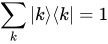
![{\displaystyle \sum _{k}f_{kj}={\frac {i}{\hbar }}{\left[\langle j|p_{z}z-zp_{z}|j\rangle \right]}=1}](https://wikimedia.org/api/rest_v1/media/math/render/svg/9256c4cbcfdc8f1d87d37c52474b7279a2ec1990)
We have calculated this for a one-electron atom, but the application to a Z-electron atom is straightforward because the Hamiltonian in Eq.\ \ref{EQ_ostre6} is quite general. In this case

Here is some eigenstate of the system, and the index describes all the eigenstates of all the electrons -- including continuum states. In cases where only a single electron will be excited, however, for instance in the optical regime of a "single-electron" atom where the inner core electrons are essentially unaffected by the radiation, the atom behaves as if it were a single electron system with Failed to parse (MathML with SVG or PNG fallback (recommended for modern browsers and accessibility tools): Invalid response ("Math extension cannot connect to Restbase.") from server "https://wikimedia.org/api/rest_v1/":): {\displaystyle Z=1} . Note that Failed to parse (MathML with SVG or PNG fallback (recommended for modern browsers and accessibility tools): Invalid response ("Math extension cannot connect to Restbase.") from server "https://wikimedia.org/api/rest_v1/":): {\displaystyle f_{kj}} is positive if Failed to parse (MathML with SVG or PNG fallback (recommended for modern browsers and accessibility tools): Invalid response ("Math extension cannot connect to Restbase.") from server "https://wikimedia.org/api/rest_v1/":): {\displaystyle \omega_{kj} > 0} , i.e. if the final state lies above the initial state. Such a transition corresponds to absorption of a photon. Since Failed to parse (MathML with SVG or PNG fallback (recommended for modern browsers and accessibility tools): Invalid response ("Math extension cannot connect to Restbase.") from server "https://wikimedia.org/api/rest_v1/":): {\displaystyle f_{jk} = -f_{jk}} , the oscillator strength for emission of a photon is negative. Our definition of oscillator strength, Eq.\ \ref{EQ_ostre3}, singles out a particular axis, the -axis, fixed by the polarization of the light. Consequently, it depends on the orientation of the atom in the initial state and final states. It is convenient to introduce the average oscillator strength (often simply called the oscillator strength), by letting Failed to parse (MathML with SVG or PNG fallback (recommended for modern browsers and accessibility tools): Invalid response ("Math extension cannot connect to Restbase.") from server "https://wikimedia.org/api/rest_v1/":): {\displaystyle |z_{kj}|^2 \rightarrow |r_{kj } |^2/3} , summing over the initial Failed to parse (MathML with SVG or PNG fallback (recommended for modern browsers and accessibility tools): Invalid response ("Math extension cannot connect to Restbase.") from server "https://wikimedia.org/api/rest_v1/":): {\displaystyle m} state and averaging over the final state.\\


- Failed to parse (MathML with SVG or PNG fallback (recommended for modern browsers and accessibility tools): Invalid response ("Math extension cannot connect to Restbase.") from server "https://wikimedia.org/api/rest_v1/":): {\displaystyle \overline{f_{kj}} = \frac{2}{3} \frac{m}{\hbar} \omega_{kj} \frac{1}{2J_j +1} \sum_{m,m^\prime} | \langle j, J_j, m^\prime |r |k,J_k , m \rangle |^2 }
(This is the conversion followed by Sobelman.) It is evident that
- Failed to parse (MathML with SVG or PNG fallback (recommended for modern browsers and accessibility tools): Invalid response ("Math extension cannot connect to Restbase.") from server "https://wikimedia.org/api/rest_v1/":): {\displaystyle \overline{f_{jk}} = - \frac{2J_j + 1}{2J_k + 1}\overline{f_{kj}} = - \frac{g_j}{g_k} \overline{f_{kj}} , }
where is the multiplicity factor for state Failed to parse (MathML with SVG or PNG fallback (recommended for modern browsers and accessibility tools): Invalid response ("Math extension cannot connect to Restbase.") from server "https://wikimedia.org/api/rest_v1/":): {\displaystyle j} . An extensive discussion of the sum rules and their applications to oscillator strengths and transition momentums can be found in Bethe and Salpeter, section 6.1. Among the interesting features they point out is that transitions from an initial state Failed to parse (MathML with SVG or PNG fallback (recommended for modern browsers and accessibility tools): Invalid response ("Math extension cannot connect to Restbase.") from server "https://wikimedia.org/api/rest_v1/":): {\displaystyle |n, \ell \rangle } to a final state Failed to parse (MathML with SVG or PNG fallback (recommended for modern browsers and accessibility tools): Invalid response ("Math extension cannot connect to Restbase.") from server "https://wikimedia.org/api/rest_v1/":): {\displaystyle |n^\prime , \ell^\prime \rangle } on the average have stronger oscillator strengths for absorption if Failed to parse (MathML with SVG or PNG fallback (recommended for modern browsers and accessibility tools): Invalid response ("Math extension cannot connect to Restbase.") from server "https://wikimedia.org/api/rest_v1/":): {\displaystyle \ell^\prime > \ell} , and stronger oscillator strengths for emission if . In other words, atoms "like" to increase their angular momentum on absorption of a photon, and decrease it on emission. The following page gives a table of oscillator strengths for hydrogen in which this tendency can be readily identified. (Taken from {\it The Quantum Mechanics of One- and Two-Electron Atoms}, H.A. Bethe and E.E. Salpeter, Academic Press (1957).) \begin{figure}[htbp]


\caption{ Oscillator strengths for hydrogen. From Mechanics of One- and Two-Electron Atoms} \end{figure}
